- I found from past experiences
that some
CS170 students get confused
when an instance method
contains an
object variable
- In this webpage, we will define an instance method
in the Card class
that compare if 2 cards are equal
We will also see an example on how such an instance method is used.
- Problem description:
- Write an instance method to
compare if
2 card objects
are equal
- The method equals
must return true if
the 2 cards are
equal
The method equals must return false otherwise.
- When are 2 cards equal to each
other:
- 2 cards are equal if the suit and the rank are equal.
Note:
- I will use a stripped down
version of the Card class
to keep the focus on
the equals() method.
I will omit the suit, suitStr, rank, and rankStr, methods...
- Write an instance method to
compare if
2 card objects
are equal
- Let us first find out
how to
use the
equals() method:
- equals is an
instance method.
So we need to use an implicit parameter to invoke the equals method.
Example:
   public class TestCard2
   {
      public static void main(String[] args)
      {
   	 Card a = new Card ( Card.CLUB, 1 );

         ... a.equals( ... ) ....
      }
   }
The parameter a is one of the tow cards in the comparison operation.
- equals compares
2 (two) cards.
So we need to pass another Card typed parameter the equals method.
Example:
   public class TestCard2
   {
      public static void main(String[] args)
      {
   	 Card a = new Card ( Card.CLUB, 1 );
   	 Card b = new Card ( Card.SPADE, 1 );

         ... a.equals( b ) ....
      }
   }
- The equals method
returns
true or false.
So we need to use the result as a boolean typed expression --- for example, in an if-else statement.
Example:
   public class TestCard2
   {
      public static void main(String[] args)
      {
   	 Card a = new Card ( Card.CLUB, 1 );
   	 Card b = new Card ( Card.SPADE, 1 );

         if ( a.equals( b )
	    System.out.println(a + " is equal to " + b);
         else
	    System.out.println(a + " is NOT equal to " + b);
      }
   }
- equals is an
instance method.
- Java program that uses the
equals() method:
   public class TestCard2
   {
      public static void main(String[] args)
      {
   	 Card a = new Card ( Card.CLUB , 1 );
   	 Card b = new Card ( Card.SPADE, 1 );
   	 Card c = new Card ( Card.CLUB , 1 );

   	 if ( a.equals(b) )
   	    System.out.println(a + " is equal to " + b);
   	 else
   	    System.out.println(a + " is NOT equal to " + b);


   	 if ( a.equals(c) )
   	    System.out.println(a + " is equal to " + b);
   	 else
   	    System.out.println(a + " is NOT equal to " + b);
      }
   }
- Initial attempt
   public class Card
   {
      public static final int SPADE   = 4;
      public static final int HEART   = 3;
      public static final int CLUB    = 2;
      public static final int DIAMOND = 1;

      private static final String[] Suit = { "*", "d", "c", "h", "s"};
      private static final String[] Rank = { "*", "*", "2", "3", "4",
   			   "5", "6", "7", "8", "9", "10", "J", "Q", "K", "A"};

      private byte cardSuit;
      private byte cardRank;

      public Card( int suit, int rank )
      {
   	 if ( rank == 1 )
   	    cardRank = 14;     // Give Ace the rank 14
   	 else
   	    cardRank = (byte) rank;

   	 cardSuit = (byte) suit;
      }

      /* ----------------------------------------------------
   	 equal(): Compare if 2 cards are equal
   	 ----------------------------------------------------  */
      public boolean equals( Card x )
      {
         ... I see ONLY ONE Card object: x
	 ... Where is the other Card object that I need to
	 ... compare with ????
      }


      public String toString()
      {
   	 return ( Rank[ cardRank ] + Suit[ cardSuit ] );
      }
   }
Some cs170 students are puzzled by the fact that they only see one Card parameter variable
and they need to compare two (2) cards !!!!
- Solution:
the other card is the
implicit parameter this !!!
   public class Card
   {
      public static final int SPADE   = 4;
      public static final int HEART   = 3;
      public static final int CLUB    = 2;
      public static final int DIAMOND = 1;

      private static final String[] Suit = { "*", "d", "c", "h", "s"};
      private static final String[] Rank = { "*", "*", "2", "3", "4",
   			   "5", "6", "7", "8", "9", "10", "J", "Q", "K", "A"};

      private byte cardSuit;
      private byte cardRank;

      public Card( int suit, int rank )
      {
   	 if ( rank == 1 )
   	    cardRank = 14;     // Give Ace the rank 14
   	 else
   	    cardRank = (byte) rank;

   	 cardSuit = (byte) suit;
      }

      /* ----------------------------------------------------
   	 equal(): Compare if 2 cards are equal

           You only see ONE card object: x
           Students often forget that INSTANCE methods
           ALWAYS have an IMPLICIT parameter "this"
           --- that's the other card !!!
   	 ----------------------------------------------------  */
      public boolean equals( Card x )
      {
   	 if ( this.cardSuit == x.cardSuit &&
   	      this.cardRank == x.cardRank    )
   	    return ( true );
   	 else
   	    return ( false );
      }

      public String toString()
      {
   	 return ( Rank[ cardRank ] + Suit[ cardSuit ] );
      }
   }
Output:
   Ac is NOT equal to As
   Ac is equal to As
- Example Program:
(Demo above code)

- The Cards.java Prog file with the equals() method: click here
- The TestCards2.java Prog file: click here
How to run the program:
- Right click on link and
save in a scratch directory
- To compile: javac TestCard2.java
- To run: java TestCard2
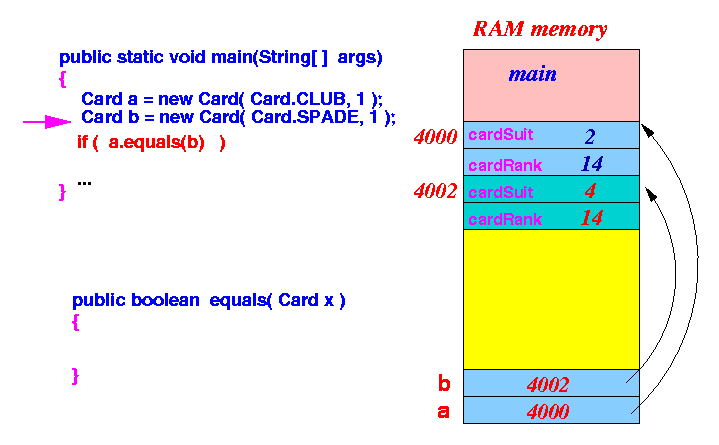
- This is what happens behind the scenes:
- First, two Card objects
a and b
are created:
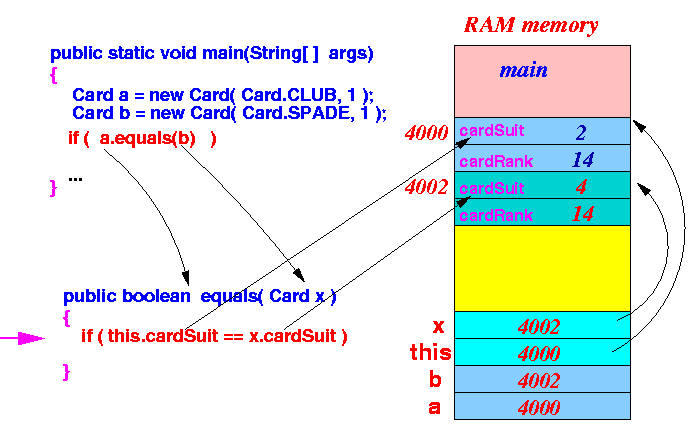
- The method call
"a.equals(b)"
passes:
- a as the implicit parameter this
- b as the explicit parameter x
- First, two Card objects
a and b
are created:
- Consider the equals() method:
      public boolean equals( Card x )
      {
   	 if ( this.cardSuit == x.cardSuit &&
   	      this.cardRank == x.cardRank    )
   	    return ( true );
   	 else
   	    return ( false );
      }
Local and parameter variables defined in equals():
- Parameter variables: x
- Local variables: none
- Conclussion:
- There is no name conflict with the instance variable name cardSuit
- There is no name conflict with the instance variable name cardRank
So we can use the short hand notation and drop the this. object variable without any problems:
      public boolean equals( Card x )
      {
   	 if ( cardSuit == x.cardSuit &&
   	      cardRank == x.cardRank    )
   	    return ( true );
   	 else
   	    return ( false );
      }
- Try it yourself:
- Delete this. from the above program and compile...