- C++ has the
new operator that
is identical to
Java's own new operator
(So I don't need to spend much time explaining what it does.
I have explained new before, if you need a refresher, see: click here)
- Syntax of C++'s
new operator:
new TYPE // Allocate space to store ONE variable of // the type TYPE new TYPE [ N ] // Allocate space to store N variables of // the type TYPE - Just like in Java, the new in C++ returns the address of the reserved memory block
- The new
operator returns
an address
- A reference variable
can store an address
- Clearly, we must use
a reference variable
to store the address
returned by new
- Example:
   int *p;    // p can store an address
   int i;

   p = new int[10];

   // We are using array notation with a pointer variable !
   p[0] = 12; p[1] = 23; p[2] = 34; p[3] = 45; p[4] = 56;
   p[5] = 67; p[6] = 78; p[7] = 89; p[8] = 90; p[9] = 111;

   for ( i = 0; i < 10; i++ )
   {
      cout << p[i] << " ";
   }
- Graphically, this data structure is created by the
above code:
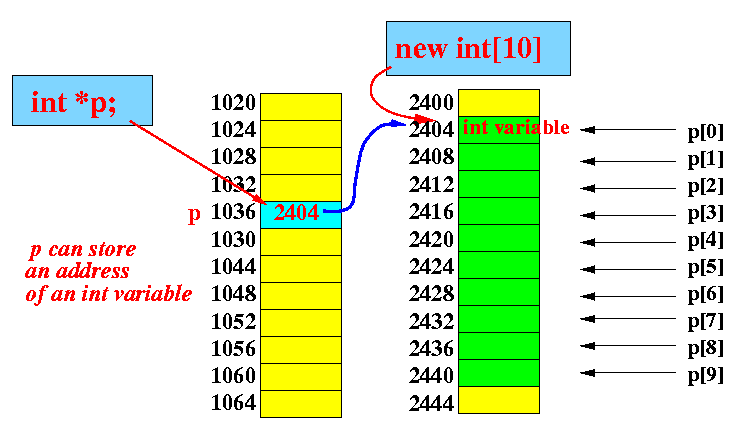
- NOTE:
- The above data structure should look
familiar to you...
- It is the same way that
an array is stored in
Java !!!
- Example:
   int[] a;

   a = new int[10];
results in:
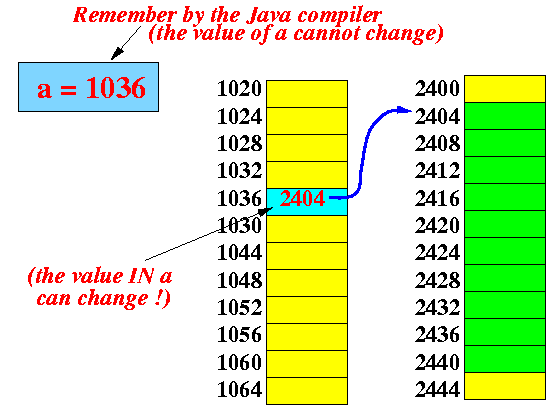
- The above data structure should look
familiar to you...
- Unlike Java,
the C++ programming language
does not provide
a garbage collection system
to reclaim
garbage
- Recall that garbage is
an inaccessible variable
that was previous created by the
new operator.
Example:
ListElem p; p = new ListElem; Result:
p = new ListElem; // Overwrites p with a new address Result:
The first ListElem can no longer be accessed (because the location is "forgotten")
Such memory variable is known as garbage
- When a dynamically
created/allocated variable is
no longer used (needed),
you must de-allocate the
reserved memory using:
delete PointerVariable;Example:
   ListElem p;

   p = new ListElem;      // Allocate space for one ListElem variable

   ...


   delete p;       // **** Deallocate space allocated !!!
- Arrays in Java is
dynamic
This means that the size of an array in Java can change during the program execution
- In contrast, Arrays in C++ is
static
This means that the size of an array in C++ cannot change during the program execution
- BUT....,
C++ does support
dynamic arrays using
pointer variables
- Example: double the size of an array
   int i, N;
   int *p, *q;

   /* ------------------------------------
      Make an array
      ------------------------------------ */
   N = 10;
   p = new int[N];        // array of 10 elements

   for ( i = 0; i < N; i++ )
       p[i] = i;


   /* ------------------------------------
      Double the side of the array
      ------------------------------------ */
   q = new int[2*N];      // array of 20 elements

   for ( i = 0; i < N; i++ )
       q[i] = p[i];       // Copy old array to new array


   delete(p);       // **** Remember to free unused space !!!

   p = q;                 // Switch p over to the new array
   N = 2*N;               // Remember new array size
- Example Program:
(Demo above code)

- Prog file: click here
- The new operator in
C++ is just like the one in Java which
is used to
reserve unused memory
- But unlike Java,
the C++ programming language
does not have a
garbage collector
- Very very very Important fact:
- You must return the reserved memory obtained by new when the variable (memory) become unnecessary