- Review of the Rectangle Rule:
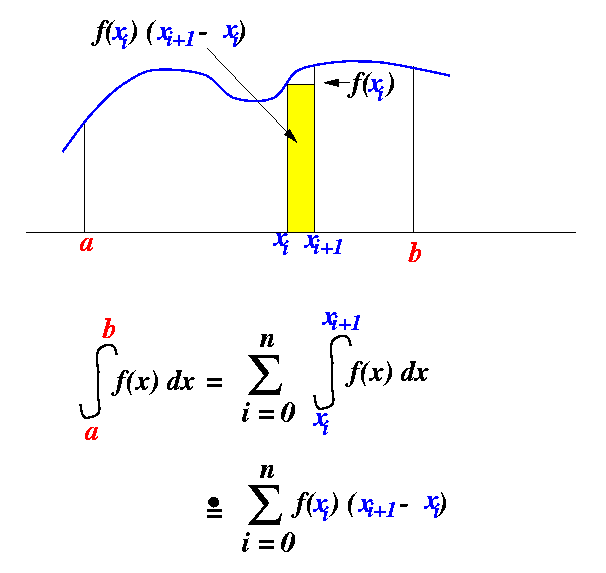
- Program formulation (global description):
- Need a function f(x)
- Need a start value a
- Need a stop value b
- Need the number of segments (intervals)
N
- Algorithm:
- Compute the step size
h = (b-a)/N
- Compute the sum:
I = f(a)*h + f(a+h)*h + f(a+2h)*h + ... + f(a + (N-1)h)*h
- Approximate integral = I
- Compute the step size
h = (b-a)/N
- Program in Pseudo Code:
a = start of interval b = end of interval N = # segments ====================================== integral = 0.0 h = (b-a)/N x = a for i = 1 to N { integral = integral + f(x)*h x = x + h } - Implementation:
float f(float x)
{
   return(x*x);
}

int main(int argc, char *argv[])
{
   extern float f(float);

   float  a, b, h, x, integral;
   int    N, i;

   cout << "Enter start of interval: ";
   cin >> a;

   cout << "Enter end of interval: ";
   cin >> b;

   cout << "Enter N (number of segments): ";
   cin >> N;

   integral = 0.0;

   h = (b-a)/N;                   // Compute step size

   x = a;
   for (i = 1; i <= N; i = i + 1)
   {
      integral = integral + f(x)*h;     // f(x) = f(a), f(a+h), f(a+2h)...
      x = x + h;			// x = a, a+h, a+2h, etc
   }

   cout << "Approximate finite integral = " << integral << "\n";

}
-
Example Program:
(shows function using Rectangle Rule) ---
click here

- Compile with: CC rect-rule1.C
- Run: a.out
- Inflexible...
- The program must use
the function with name
f
- If we need to find the integral of
2 different functions
the program will be useless.
Example: the program cannot compute:
Integral( f(x) from a to b) ------------------------------- Integral( g(x) from a to b) - The Rectangle Rule algorithm cannot be easily used by other programs
- The program must use
the function with name
f
- Rapid growth in program complexity...
- This is a small program, but unless you organise the program into modules, the effort to maintain program correctness will increase rapidly
- Computer program parts can be
broadly categorized
into:
- "Utilities"/"Library functions" : Functions that perform a certain task
- Applications: programs that coordinate the steps to achieve the desire result
- "Utilities"/"Library functions"
are best stored in
different files
(and combined together in the final program compilation)
- Here is an example on how to put functions, subroutines and
main program into separate files; and how to compile them into
one program:
  // This function is
  // CHANGED often
  // -- keep separate

  float f(float x)
  {
     return(x*x);
  }
// The algorith // does NOT CHANGED // often // Declare function f before its use !!! extern float f(float); int main(int argc, char *argv[]) { float a, b, h, x, integral; int N, i; ...input a, b, N integral = 0.0; h = (b-a)/N; x = a; for (i = 1; i <= N; i = i + 1) { integral = integral + f(x)*h; x = x + h; } }
- Example Program:
(Demo above code)

- The Main program containing the Rectangle Rule: click here
- The Function subprogram containing the function f(x): click here
- How to run:
- CC -c rect-rule2a.C
- CC -c rect-rule2b.C
- CC -o rect-rule2 rect-rule2a.o rect-rule2b.o
- rect-rule2
- NOTE:
- This is
NOT New
- You have seen separate compilation before: click here
- This is
NOT New
- In the Rectangle Rule program, we discern a
clear and definite task:
-
Determine (an approximation) of a definite integral
- Unfortunately, the
function
that implements this task is
a
main program :
  int main(int argc, char *argv[])
  {

     float  a, b, h, x, integral;
     int    N, i;

     ...input a, b, N


     // Algorithm is "stuck" in the main program
     integral = 0.0;

     h = (b-a)/N;
     x = a;

     for (i = 1; i <= N; i = i + 1)
     {
        integral = integral + f(x)*h;
        x = x + h;
     }

  }
As the main program , it cannot be easily deployed in other programs.
- The principle of modular programming
(to manage program complexity) is:
Implement well-defined task/operations as one or more functions Example:
  int main(int argc, char *argv[])
  {

     float  a, b, h, x, integral;
     int    N, i;

     ...input a, b, N


     // Well-defined task implemented as a FUNCTION

     integral = Rectangle_Rule(.....);

  }
- In order to implement a function
to
perform a well-defined task
we must first determine
- Input information
needed to perform the task:
input parameters
- How to convey results to the user: output parameters
- Input information
needed to perform the task:
input parameters
- Example:
- Input information
needed by the
Rectangle Rule algorithm:
- The function to integrate
- Start and end of the interval
- Number of small intervals
- Output
produced by the
Rectangle Rule algorithm:
- A real value representing the approximation of the integral
- Input information
needed by the
Rectangle Rule algorithm:
- Implementing the Rectangle Rule algorithm
as a function:
  float RectangleRule(float f(float), float a, float b, int N)
  {
     float integral, h, x;
     int   i;

     integral = 0.0;

     h = (b-a)/N;
     x = a;

     for (i = 1; i <= N; i = i + 1)
     {
        integral = integral + f(x)*h;
        x = x + h;
     }

     return(integral);
  }
This example uses the knowledge about passing function as parameter discussed in this webpage: click here
- Using the RectangleRule()
function in a main program
  // Declare function f
  extern float f(float);

  // Declare function RectangleRule
  extern float RectangleRule(float f(float),
                             float, float, int);

  int main(int argc, char *argv[])
  {
     float  a, b, integral;
     int    N;

     cout << "Enter start of interval: ";
     cin >> a;

     cout << "Enter end of interval: ";
     cin >> b;

     cout << "Enter N (number of segments): ";
     cin >> N;

     integral = RectangleRule(f, a, b, N);   // Use RectangleRule !!!

     cout << "Approximate finite integral = " << integral << "\n";
  }
- Example Program:
(Rectangle Rule as a function) ----------
- The RectangleRule(f,a,b,N) function: click here
- The Main program (driver program): click here
- Some function f(x):
click here
- Compile them with:
- CC -c rect-rule-func.C
- CC -c rect-rule3.C
- CC -c rect-rule2b.C
- CC -o rect-rule3 rect-rule3.o rect-rule-func.o rect-rule2b.o