Syntax of the
complete
SELECT command
|
Review:
the effect of the
GROUP BY operation
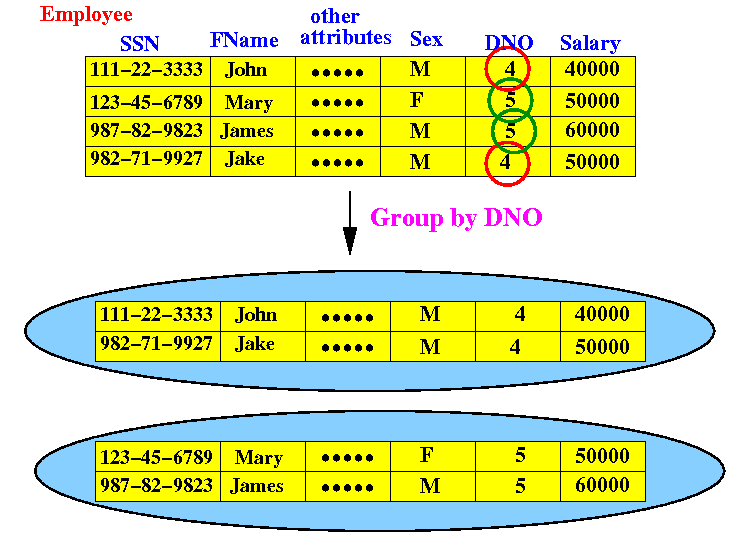
The effect of the GROUP BY DNO operation is:
|
It separates the tuples in different groups based on the value in the DNO attribute
What can you do
after forming
groups ?
After forming groups:
|
|
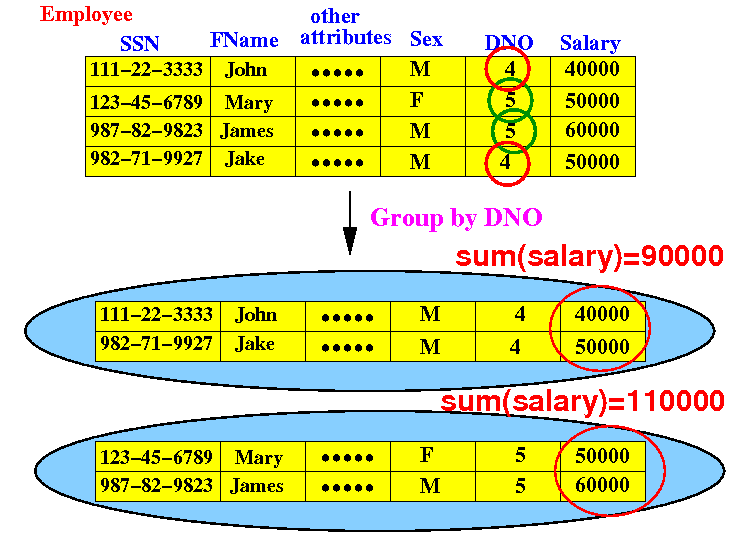
We can apply set functions on each group separately !!!
What can you do
after forming
groups ?
Example: total salary paid to employees per department:
|
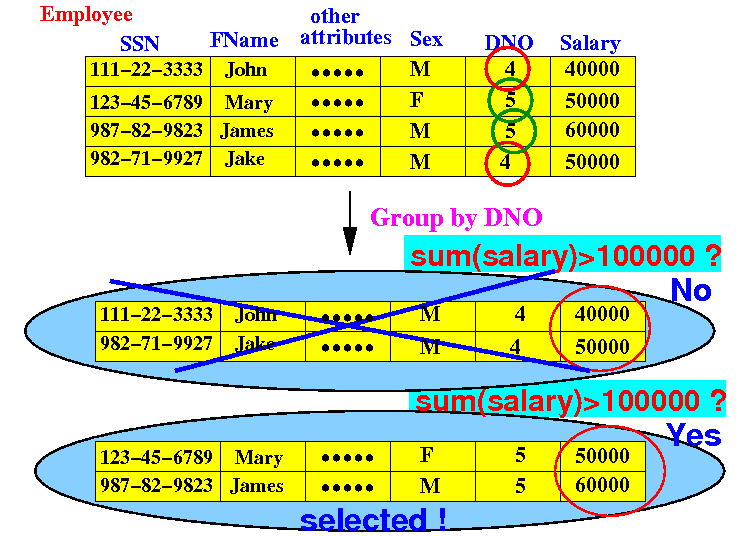
We can also use set functions to select certain groups !!!
How can you
select groups ?
Example: find departments with payroll > $100,000
|
You can see here how we used a set function to select certain groups !!!
How can you
select groups ?
Example: find departments with payroll > $100,000
Expressed in SQL:
SELECT dno, sum(salary) FROM employee GROUP BY dno HAVING sum(salary) > 100000 |
Practice SQL queries that uses the
HAVING clause
|
The meaning of the SQL
SELECT command
|
How SQL processes
a SELECT query
    SELECT    dno, sum(salary)
    FROM      employee
    WHERE     sex = 'M'
    GROUP BY  dno
    HAVING    count(*) > 2

 Result so far:

       ssn       fname  lname    sex dno salary
       --------- ------ -------- --- --- --------
       123456789 John   Smith    M     5 30000.00
       333445555 Frankl Wong     M     5 40000.00
       999887777 Alicia Zelaya   F     4 25000.00
       987654321 Jennif Wallace  F     4 43000.00
       666884444 Ramesh Narayan  M     5 38000.00
       453453453 Joyce  English  F     5 25000.00
       987987987 Ahmad  Jabbar   M     4 25000.00
       888665555 James  Borg     M     1 55000.00
|
How SQL processes
a SELECT query
    SELECT    dno, sum(salary)
    FROM      employee
    WHERE     sex = 'M'
    GROUP BY  dno
    HAVING    count(*) > 2

 Result so far:

       ssn       fname  lname    sex dno salary
       --------- ------ -------- --- --- -------- (non-relevant
       123456789 John   Smith    M     5 30000.00  attributes
       333445555 Frankl Wong     M     5 40000.00  omitted)
       999887777 Alicia Zelaya   F     4 25000.00
       987654321 Jennif Wallace  F     4 43000.00
       666884444 Ramesh Narayan  M     5 38000.00
       453453453 Joyce  English  F     5 25000.00
       987987987 Ahmad  Jabbar   M     4 25000.00
       888665555 James  Borg     M     1 55000.00
|
How SQL processes
a SELECT query
    SELECT    dno, sum(salary)
    FROM      employee
    WHERE     sex = 'M'
    GROUP BY  dno
    HAVING    count(*) > 2

 Result so far:

       ssn       fname  lname    sex dno salary
       --------- ------ -------- --- --- -------- (non-relevant
       123456789 John   Smith    M     5 30000.00  attributes
       333445555 Frankl Wong     M     5 40000.00  omitted)


       666884444 Ramesh Narayan  M     5 38000.00

       987987987 Ahmad  Jabbar   M     4 25000.00
       888665555 James  Borg     M     1 55000.00
|
How SQL processes
a SELECT query
    SELECT    dno, sum(salary)
    FROM      employee
    WHERE     sex = 'M'
    GROUP BY  dno
    HAVING    count(*) > 2

 Result so far:

       ssn       fname  lname    sex dno salary
       --------- ------ -------- --- --- --------
       123456789 John   Smith    M     5 30000.00
       333445555 Frankl Wong     M     5 40000.00  (1 group)
       666884444 Ramesh Narayan  M     5 38000.00

       987987987 Ahmad  Jabbar   M     4 25000.00  (1 group)

       888665555 James  Borg     M     1 55000/00  (1 group)
|
How SQL processes
a SELECT query
SELECT dno, sum(salary)
FROM employee
WHERE sex = 'M'
GROUP BY dno
HAVING count(*) > 2
Result so far:
ssn fname lname sex dno salary
--------- ------ -------- --- --- --------
123456789 John Smith M 5 30000.00
333445555 Frankl Wong M 5 40000.00 (1 group)
666884444 Ramesh Narayan M 5 38000.00
|
How SQL processes
a SELECT query
SELECT dno, sum(salary) ===> dno sum(salary)
FROM employee --- ---------------
WHERE sex = 'M' 5 108000.00
GROUP BY dno
HAVING count(*) > 2
Result so far:
ssn fname lname sex dno salary
--------- ------ -------- --- --- --------
123456789 John Smith M 5 30000.00
333445555 Frankl Wong M 5 40000.00 (1 group)
666884444 Ramesh Narayan M 5 38000.00
|