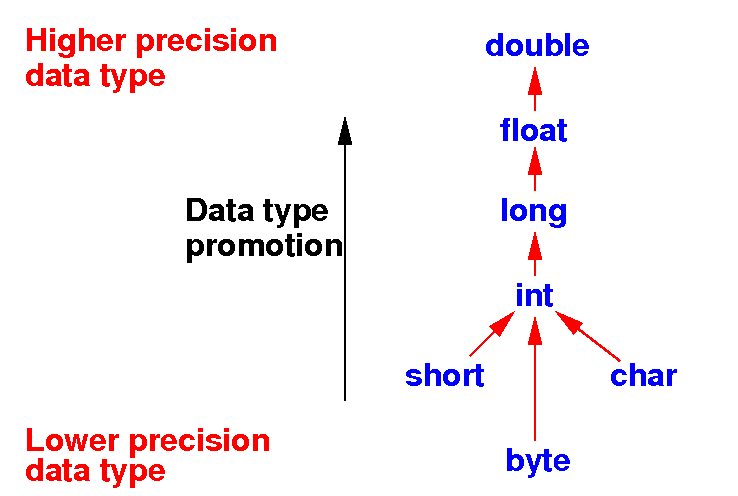
Value ranges of Java Primitive types and type conversion

  • Value ranges of Java primitive data types:

      double:    -1.7976931348623157E+308   ---  +1.7976931348623157E+308 
      float:     -3.4028235E+38             ---  +3.4028235E+38 
    
      long:      -9223372036854775808       ---   9223372036854775807
      int:       -2147483648                ---   2147483647
      short:     -32768                     ---   32767
      byte:      -128                       ---   127
    
    
    double contains all values in float, long, int, short and byte float contains all values in long, int, short and byte long contains all values in int, short and byte int contains all values in short and byte short contains all values in byte

  • The computer has circuitry that can convert a value of any primitive data type to any other primitive data type

Problem:    assigning/converting different data types

Assigning/converting a value in a float to a double:
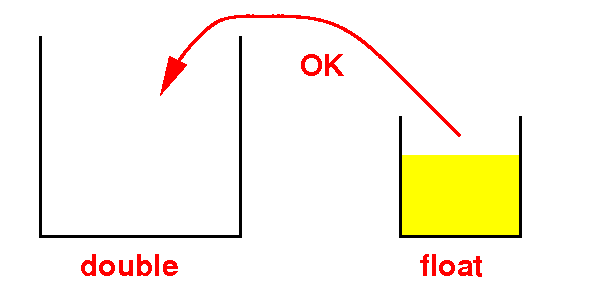
  It will always "fit" because double contains all values in float

  Therefore:

      Assigning/converting a value in a float to a double can never
      result in "overflow" error 

Problem:    assigning/converting different data types

Assigning/converting a value in a double to a float:
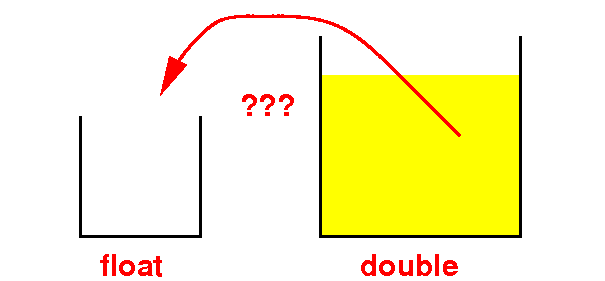
  It may result in overflow because some double are not in float !!!

  Example:

         1.0E300  (10300) is a double value
         But this value cannot be stored as a float

DEMO: demo/02-elem-prog/07-mixed-datatype/StoreFloat.java

  Programming rule for the assignment statement b = a in Java  

  • The assignment

       b = a
    

    is only allowed if:

    • The value range of data type of b contains the value range of data type of a

    Examples:

       short  a;
       int    b;
       float  c;
       double d;
    
       d = a;        // Allowed
       c = b;        // Allowed
       a = d;        // Disallowed
       b = c;        // Disallowed
    

DEMO: demo/02-elem-prog/07-mixed-datatype/DemoAssignment.java

  Casting: converting one data type to another data type  

  • Casting:

    • Casting = converting the data representation from one data type to another data type (the conversion happens using computer circuitry)

    (The details of a type conversion is complex and not covered in AP Computer Science)


  • The casting operation in Java is denoted as follows:

     (datatype) value // Convert the value into the data type (datatype)
    

    Example:

     short  a;
     double d;
    
     a = d;         // Disallowed
     a = (short) d; // Allowed, because d was converted to a short data type
    

DEMO: demo/02-elem-prog/07-mixed-datatype/Casting.java

Rounding float and double to integers


  • When you assign/convert a float or double to an integer, the decimal part will be truncated

    Example:

    public class FloatToInt 
    {
       public static void main(String[] args) 
       {
          int x;
          
          x = (int) 3.14;   // x = 3  (0.14 is truncated)
          x = (int) 6.99;   // x = 6  (0.99 is truncated)
       }
    }  

DEMO: demo/02-elem-prog/07-mixed-datatype/FloatToInt.java

Rounding float and double to integers


  • If you want to round a float or double values to an integer, first add 0.5 and then cast

    Example:

    public class RoundFloatToInt 
    {
       public static void main(String[] args) 
       {
          int x;
          
          x = (int) (3.14+0.5);   // = 3.54, cut off --> x = 3
          x = (int) (6.99+0.5);   // = 7.49, cut off --> x = 7
       }
    }  

DEMO: demo/02-elem-prog/07-mixed-datatype/RoundFloatToInt.java

  Background information: Computer can only add, subtract, multiple, divide with same type of values  

  • Computer circuitry can only perform operations on 2 values of the same data type

    Examples:

      double + double   double - double    double * double   double / double 
      float  + float    float  - float     float  * float    float  / float
    
      long   + long     long   - long      long   * long     long   / long  
      int    + int      int    - int       int    * int      int    / int
      short  + short    short  - short     short  * short    short  / short
      byte   + byte     byte   - byte      byte   * byte     byte   / byte
    

  • Mixed data type operations:

    1. Java will first perform one or more convert (=cast) operation(s) to make operands into the same data type

    2. and then perform the operation

  Data type promotion in Java in mixed type operations  

  • When Java performs an arithmetic operation on different data types, the "smaller" data type is converted ("promoted") to the "larger" data type

  • Data type promotion in arithmetic operations in Java when using different data types:

  • Additional rule:

    • In Java, integer operations are always performed (= converted) in int

  Example 1 of data type promotion in Java  
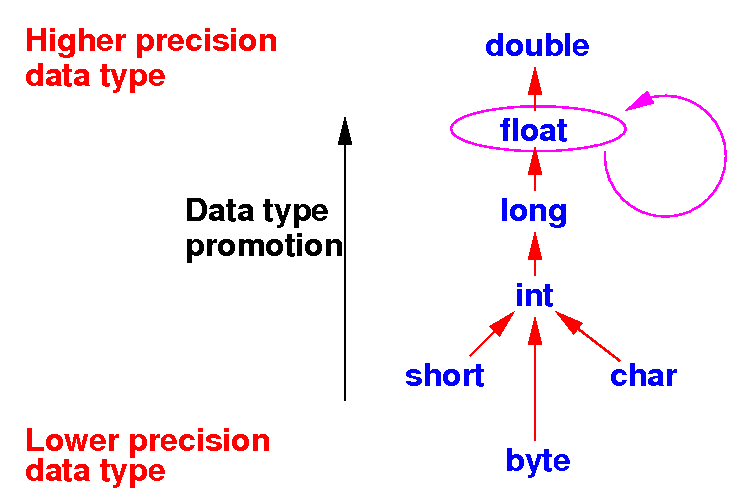
  • Example 1:

     Evaluate:             How Java evaluates a + b
    
        float a;           (float) a + (float) b // No promotion necessary
        float b;
    
        a + b              Result is a float
    

DEMO: demo/02-elem-prog/07-mixed-datatype/TypePromo1.java

  Example 2 of data type promotion in Java  
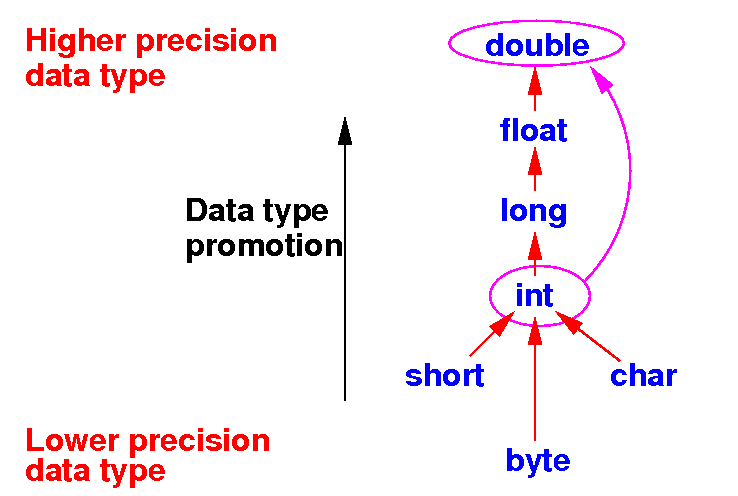
  • Example 2:

     Evaluate:             How Java evaluates a + b
    
        double a;          (int) a    + (double) b  // Promote a to double
        int    b;          (double) a + (double) b
    
        a + b              Result is a double
    

DEMO: demo/02-elem-prog/07-mixed-datatype/TypePromo1.java

  Example 3 of data type promotion in Java  
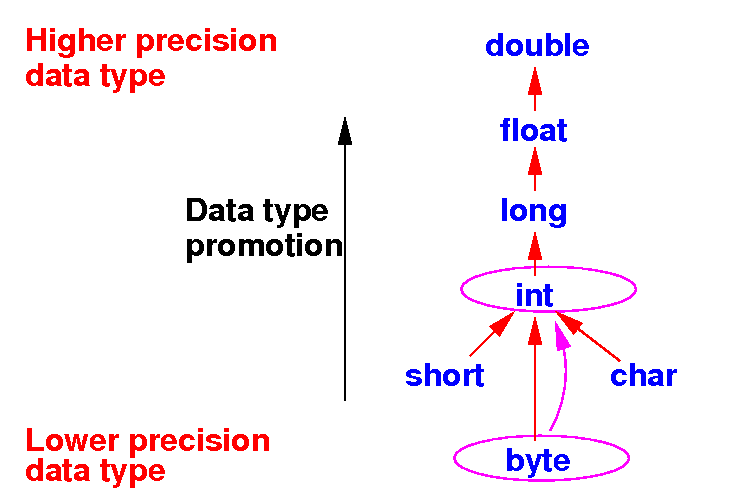
  • Example 3:

     Evaluate:             How Java evaluates a + b
    
        byte   a;          (byte) a  +  (byte) b // Promote a and b to int
        byte   b;          (int)  a  +  (int)  b
    
        a + b              Result is a int
    

DEMO: demo/02-elem-prog/07-mixed-datatype/TypePromo1.java

  Combining assignment with mixed data type operations  

  • Rule:   the assignment:  

     x = value from a mixed data type operation 
    

    is only allowed if:

    • The value range of data type of x contains the value range of result of the mixed data type operation

    Examples:

       byte   a = 1;
       int    b = 2;
       float  c = 3;
       double d = 4;
    
       d = a + c;    // Allowed (a + c is a float)
       a = a + 1;    // Disallowed (a + 1 is an int)
    

DEMO: demo/02-elem-prog/07-mixed-datatype/AssignMixed.java

Mixed type operation: ---- more practice

  • For each of the assignment statement:

    • State if the assignment statement has an error (explain why)

    • If no error, give the value stored in the destination variable

    Program:

    public class Quiz
    {
       public static void main(String[] args)
       {
          double answer1 = 3.0 * 5 / 3;   
          double answer2 = 3.0 + 5 / 3;    // Tricky !
    
          double answer3 = 5.0 / 3 * 3.0; 
          double answer4 = 5 / 3 * 3.0;    // Tricky !
    
          int    answer5 = 1 + 2.0 + 3;    
       }                       
    }  

DEMO: demo/02-elem-prog/07-mixed-datatype/Quiz.java

Mixed type operation: Fahrenheit --> Celsius

Google: Fahrenheit to Celcius (to find conversion formula)

Fix the error(s) in the program below:

public class FtoC
{
   public static void main(String[] args)
   {
      double F = 70.0;
      double C;             // Answer should be: 21.11111

      C = 5 / 9 * ( F - 32 );
   }                       
}
  

DEMO: demo/02-elem-prog/07-mixed-datatype/FtoC.java