Review:
Method Signature
The
(1) method name
and the
(2) parameter list
together constitutes the
method signature:
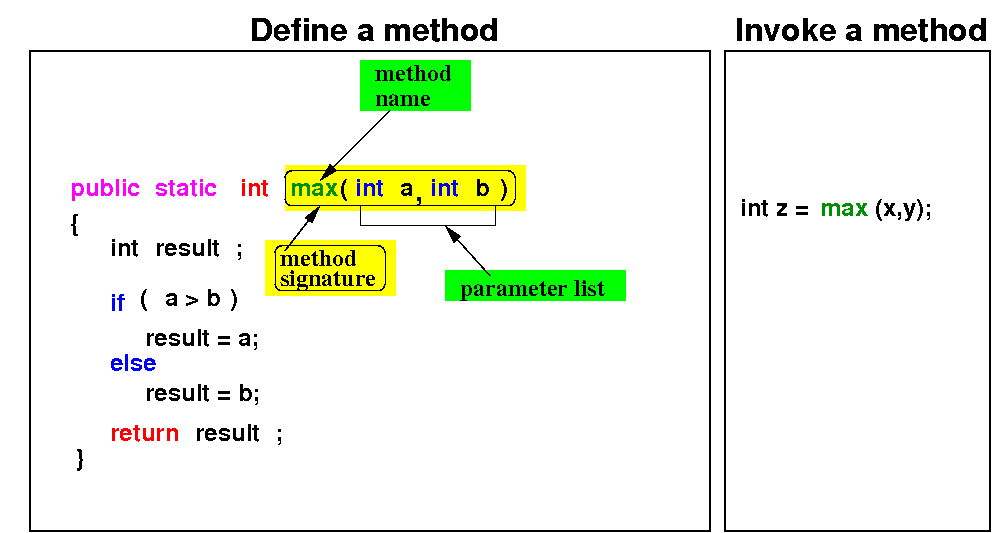
The
method signature
is used to
identify a
method
Therefore:
a
class
cannot
have
more than 1 method with the
same
method signature.
Method overloading
- A method is
overloaded when:
Example:
    public static void print(short x)
    {
        System.out.println("short: " + x);
    }

    public static void print(int x)
    {
        System.out.println("int: " + x);
    }

    public static void print(double x)
    {
        System.out.println("double: " + x);
    }
|
|
How Java select methods:
(1)
method signatures
match exactly
- The Java compiler
determines which method
to
use
by
matching
the
method signatures:
- Java will
select/use
a method
with the
exact matching
signature as the
arguments
if one can be
found
|
Examples:
    public static void main(String[] args)
    {
        short  a = 1;
        int    b = 1;
        double c = 1;

        print(a);      // Invokes  print(short x)
        print(b);      // Invokes  print(int x)
        print(c);      // Invokes  print(double x)
    }
|
|
DEMO:
demo/06-methods/05-method-signature/ExactMatch.java
---
Step to
show diff method invocations
How Java select methods:
(2) no exact matching
method signatures
- If
no method with
exact matching
method signature can be
found:
- Java will
promote
the
data type
of the
arguments
to the
nearest
"larger" type
until a
matching
method signature
can be found
                          char
 Data type                  \
 promotion:   byte -> short --> int -> long -> float -> double
|
|
Examples:
 byte a = 1;
 print(a);    // Promotion: byte --> short  to find print(short x)
              // Invokes    print(short x)  (not print(int x))

 float c = 1;
 print(c);    // Promotion: float --> double  to find print(double x)
              // Invokes    print(double x)
|
|
DEMO:
demo/06-methods/05-method-signature/NoExactMatch.java
Method selection
ambiguity
- Method selection
ambiguity:
- If there are
different ways
to find a matching
method signature,
Java will
report an
error
|
-
Example of
an
ambigious selection:
    public static void main(String[] args)
    {
       int a = 4, b = 5;

       print(a,b); // (1) promote b to double --> uses print(int, double)
                   // (2) promote a to double --> uses print(double, int)
    }

    public static void print(int x, double y)
    {
        System.out.println("int x:" + x + " double: " + y);
    }

    public static void print(double x, int y)
    {
        System.out.println("double: " + x + " int: " + y);
    }
|
|
DEMO:
demo/06-methods/05-method-signature/AmbiguousSelection.java
Good programming practice
- Recommendation:
-
Do not
allow
Java
to select a
method
by
type promotion
|
-
Force the
choice of the
methods by
yourself
using
casting:
    public static void main(String[] args)
    {
       int a = 4, b = 5;

       print((double)a, (int)b);  // Calls: print(double, int)
    }

    public static void print(int x, double y)
    {
        System.out.println("int x:" + x + " double: " + y);
    }

    public static void print(double x, int y)
    {
        System.out.println("double: " + x + " int: " + y);
    }
|
|
DEMO:
demo/06-methods/05-method-signature/MakeExplicit.java
❮
❯