Review:   accessing members of an object

  • An object's member can refer to:

      • A data field in the object         or      
      • A method in the object

  • After an object is created, its data can be accessed and its methods can be invoked using the dot operator (.):

     objectRefVar.dataField  references a data field in the object.
    
     objectRefVar.method(arguments)  invokes a method on the object

  • The dot (.) operator is also known as the object member access operator

So: members in an object is always accessed through a reference variable.

Where is reference variable used by the instance methods ???

Consider the instance methods in the Circle class definition again:

public class Circle
{
    public double radius = 1;       /** The radius of this circle */

    public Circle() { }             /** Constructor 1 for a circle object */

    public Circle(double newRadius) /** Constructor 2 for a circle object */
    {
        radius = newRadius;
    }

    public double getArea()      /** Return the area of this circle */
    {
        return 3.14159 * radius * radius;
    }

    public void setRadius(double newRadius) /** Set new radius for this circle */
    {
       radius = newRadius;
    }
} 

We access the member variable radius without using any reference variable !!!   How is this possible ???

The implicit (= hidden) parameter this

Here is the dirty little secret about Java's instance methods:

  • An instance method is always invoked using an object reference variable:

     objectRefVar.method(arguments)  invokes a method on the object  

  • The variable objectRefVar is also passed to an instance method as a implicit (= hidden) parameter

    The name of the implicit (= hidden) parameter is called:

             this  

  • Let's make the hidden parameter this explicit

    (I.e.: reveal where the Java compiler uses the hidden parameter)

The implicit (= hidden) reference variable this used by the instance methods

Suppose we write the instance methods in the Circle class as:

public class Circle
{
    public double radius = 1;       /** The radius of this circle */

    public Circle() { }             /** Constructor 1 for a circle object */

    public Circle(double newRadius) /** Constructor 2 for a circle object */
    {
        radius = newRadius;
    }

    public double getArea()      /** Return the area of this circle */
    {
        return 3.14159 * radius * radius;
    }

    public void setRadius(double newRadius) /** Set new radius for this circle */
    {
       radius = newRadius;
    }
} 

Remember:   every instance method (and constructor) has a hidden parameter named this which is the object that invokes the instance method

The implicit (= hidden) reference variable this used by the instance methods

The Java compiler will insert this. to every member access:

public class Circle
{
    public double radius = 1;       /** The radius of this circle */

    public Circle() { }             /** Constructor 1 for a circle object */

    public Circle(double newRadius) /** Constructor 2 for a circle object */
    {
        this.radius = newRadius;
    }

    public double getArea()      /** Return the area of this circle */
    {
        return 3.14159 * this.radius * this.radius;
    }

    public void setRadius(double newRadius) /** Set new radius for this circle */
    {
       this.radius = newRadius;
    }
} 

Remember:   every instance method (and constructor) has a hidden parameter named this which is the object that invokes the instance method

The implicit (= hidden) parameter this

Example to illustrate the passing of the implicit parameter:

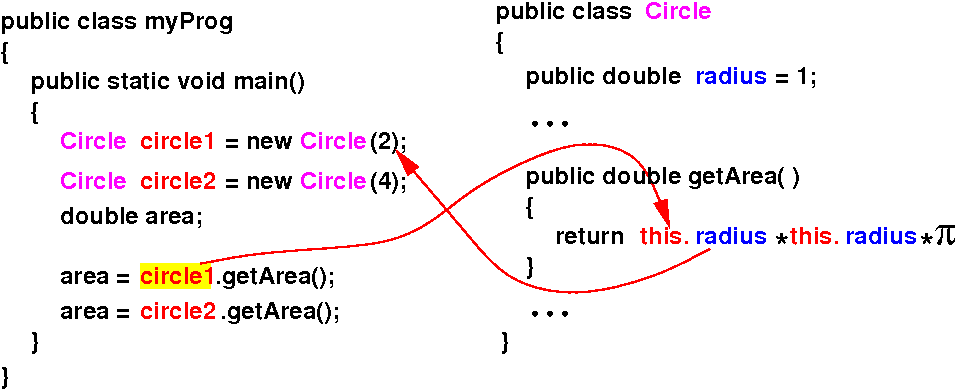
  • When we invoke circle1.getArea(), the Java compiler will "secretly" pass circle1 as this to getArea():

    Then circle1.getArea() will return 2 × 2 × π

The implicit (= hidden) parameter this

Example to illustrate the passing of the implicit parameter:

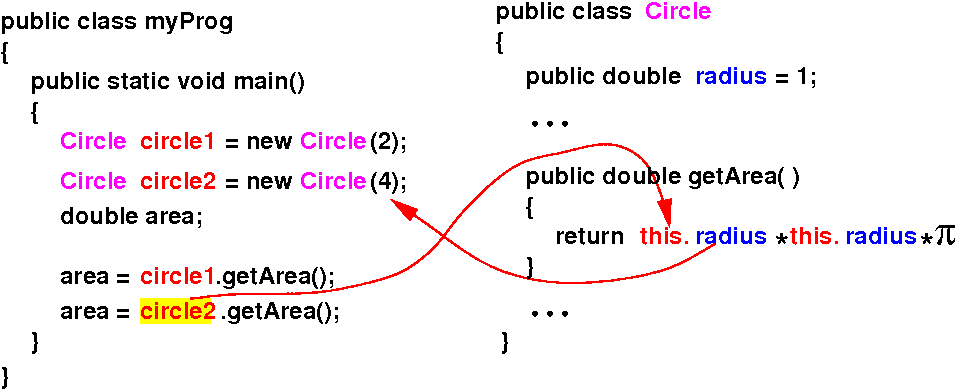
  • And when we invoke circle2.getArea(), the Java compiler will "secretly" pass circle2 as this to getArea():

    Then circle2.getArea() will return 4 × 4 × π

When is the use of this necessary ???

  • The implicit (= hidden) parameter this is almost never necessary to write Java classes.

  • There is only 1 case that I can think of when it is necessary to use the this variable (which you can easily avoid):

    • When a parameter variable has the same name as an instance variable in the class

    Example:

        /** Set new radius for this circle */
        public void setRadius(double radius)
        {
           radius = radius;  // radius is an instance variable
                             // radius = a parameter variable
        }  

    You can fix this problem with:    this.radius

Another (rare) use of this

  • The this keyword can also be used to invoke another constructor of the same class.

    Example: instead of write this:

        public double radius = 1;  /** The radius of this circle */
    
        public Circle() /** Constructor 1 for a circle object */
        {
    
        }             
    
        public Circle(double newRadius) /** Constructor 2  */
        {
            radius = newRadius;
        }
      

Another (rare) use of this

  • The this keyword can also be used to invoke another constructor of the same class.

    Which is equivalent to:

        public double radius;      /** The radius of this circle */
    
        public Circle() /** Constructor 1 for a circle object */
        {
            radius = 1;
        }             
    
        public Circle(double newRadius) /** Constructor 2  */
        {
            radius = newRadius;
        }
      

Another (rare) use of this

  • The this keyword can also be used to invoke another constructor of the same class.

    We can also call "Circle(1)" using this(1) to set radius = 1:

        public double radius;      /** The radius of this circle */
    
        public Circle() /** Constructor 1 for a circle object */
        {
            this(1);  // Calls Circle(double newRadius)
        }             
    
        public Circle(double newRadius) /** Constructor 2  */
        {
            radius = newRadius;
        }