Values

  • Value = the "worth" of something

  • Values are fundamental representations of data/information inside a computer program

  • Computer programs operate/manipulate/transform values !

  • Example of values:

      1               an integer number 
      3.14		  an floating point number
      "Hello"         a text/string with 5 letters
      True            a logical value


Data types

  • Every value has a (data) type

  • Examples:

       Value       Python Data type      
      ==============================
         1            int           the whole numbers
         3.14         float         the real numbers
         "Hello"      string        text
         True         boolean       logical values (True/False) 

  • Command to find the type of a value:

          type(value)  
    
    >>> type(4)
    <class 'int'>
    >>> type("Hello")
    <class 'str'> 

Exercise

  • What is the type of the following values:

      type(1)
    
      type("1")
    
      type(3.14)
    
      type("3.14)
    
      type(True)
    
      type("True")
    
      type('True')
      

Exercise

  • What is the type of the following values:   (Answers):

      type(1)                  integer
    
      type("1")		   string !
    
      type(3.14)		   float
    
      type("3.14)		   string !
    
      type(True)		   boolean
    
      type("True")		   string !
    
      type('True')		   string ! (single quote works too)
      

The special value None in Python

  • The special value denoted by:

          None  

    is used to denote/represent no value

  • The data type of None is:   NoneType

    >>> type(None)
    <class 'NoneType'> 

  • Note:

    • None is not the same as the integer 0 !
    • None is not the same as the empty string "" !

Why do we need a type for a value ?

  • Recall that we can only store numbers (= values) inside the computer (memory):
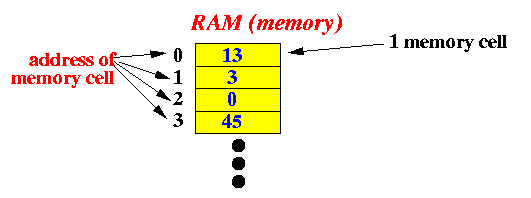
  • The data type provides the context on how to interpret the number (value)

  • Key to understand information:

      • Information   =   data (=value)   +   context (interprete data)

How computer represent (= interpret) integer values

  • Recall:   computer can store integer numbers:

  • How computers represent integer values:

      • Integer values are represented naively (= straightforwardly) using integer numbers inside a computer

How computer represent (= interpret) floating point values

  • A floating point value consists of 2 parts:

      (1) A  mantissa
      (2) An exponent
    
      Example:     123.45678   =   0.12345678 × 10³  
    
      Mantissa = 12345678      Exponent = 3

  • How computers represent floating point values:

      • Floating point values are represented using 2 integers

        1. An integer that represents the mantissa
        2. An integer that represents the exponent

    (I.e.: we need to know the type of a value in order to know how we must interpret the integer number(s) !)

How computer represent (= interpret) characters (text)

  • A text is a string of letters/symbols from som alphabet

  • Each letter/symbol of the alphabet is encoded by a unique integer value

  • The universal code used to represent all symbols in the world's lamguages is the Unicode:  

  • Examples:

     English   Character code    Other    Character code
     ========================    ==========================
       A           65             α       945  (Greek)
       B           66	      א      (1488-Hebrew)
       a	       97	      花      33457 (Chinese)
       b	       98
       0           48
       1	       49
    

    (One more example that shows that we need to know the type of a value in order to know how we must interpret the integer number(s) !)

How computer represent (= interpret) boolean values

  • There are only 2 boolean values:

      1. True
      2. False

  • How computers represent boolean values:

     False:       the number 0
     True:        any number other than 0
    

    (One more example that shows that we need to know the type of a value in order to know how we must interpret the integer number(s) !)