- Definitions:
- Component =
a digital circuit
Example:
- And gate
- Or gate
- Multiplexor
- etc
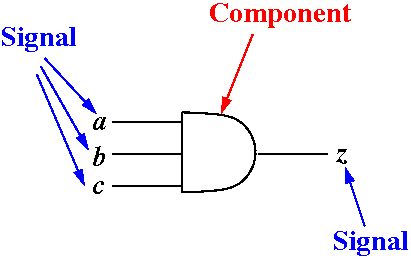
- Signal = an input or an output of a component
- Component =
a digital circuit
- Schematically:
- Important note:
- Every signal used in the
circuit simulation must be
defined !!!
- Every signal has
a unique identifier
- A signal can optionally has a display name
- Every signal used in the
circuit simulation must be
defined !!!
- Named and
unnamed signals:
- Most signals will
not be
displayed
(= shown to the user)
- The signals that you do want to display will usually receive a display name
- Most signals will
not be
displayed
(= shown to the user)
- Example: how an
unnamed signal is
displayed:

- Example: how an
named signal
(called MyOutput) is
displayed:

- Defining
signals:
    Signal signalName;                       // Defines an unnamed signal

    Signal signalName( 1, "DisplayName" );   // Define one named signal ("DisplayName")


    Sig( signalName, 1 );        // Shorthand for: Signal signalName(1, "signalName")
Examples:
    Signal a;                   // Unnamed

    Signal a(1, "MySignal");    // The signal is identified as "a" and
                                // displayed with the name "MySignal"

    Sig(a, 1);                  // The signal is identified as "a" and
                                // displayed with the name "a"
- Important Note:
- A Signal typed
variable is
always an array variable
in
logic-sim
- Furthermore:
- The signal x[0] is always equal to the signal x
That's why the signal out is displayed as out[0] in the circuit simulation:

- A Signal typed
variable is
always an array variable
in
logic-sim
- Fact:
- We often use a serie of
signals
Examples:
- The address bus consists of 32/64 bits (signals)
- The data bus consists of 32/64 bits (signals)
- We often use a serie of
signals
- Defining multiple
signals:
    Signal signalName[N];       // Unnamed

    Sig( signalName, N );       // Named (shorthand)


  Defines the signals:

          signalName[0], signalName[1], ..., signalName[N-1]
Examples:
    Signal x[4];    // Defines: x[0], x[1], x[2], x[3]

    Sig( x, 4 );    // Defines: x[0], x[1], x[2], x[3]
- Ways to use an array of
signals
- Each individual signal
in an array of
signals is
identified by
an index.
Example:
      Signal x[4];

      Individual signals:  x[0]   x[1]   x[2]   x[3]


      Sig( x, 4 );

      Individual signals:  x[0]   x[1]   x[2]   x[3]
An individual signal is used just like any ordinary signal
Example:
    Signal x[4];
    Signal out1, out2;

    And("aa", (x[0],x[1]), out1);
    And("aa", (x[2],x[3]), out2);
- You can pass an
entire array as
parameter to a
(C) function (component)
Example:
    Signal x[4];
    Signal out;

    And("aa", x, out1);  // Same as: And("aa", (x[3],x[2],x[1],x[0]), out);
- Each individual signal
in an array of
signals is
identified by
an index.
- You can use 2 types of components
in your digital simulation:
- Built-in components
- User-defined components
- Some common
built-in components:
- And gate
- Or gate
- Mux (multiplexor)
- ...
- Syntax to define a componet:
ComponentName ( Coord, Input-Signal(s), Output-Signal(s), other-params ) ;Note:
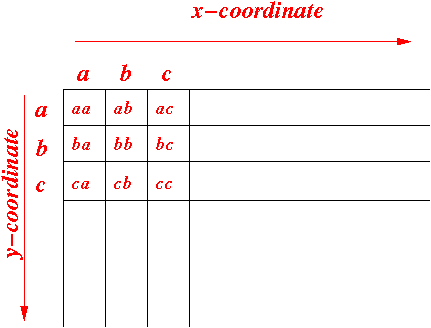
- The coord is the
coordinate on a grid
- The coord has the following
format:
"xy"
- The coordinate system is
as follows:
- The coord has the following
format:
- The input-signal(s) and output-signal(s) are Signal typed variables that must have been defined before they can be used !!!
- The coord is the
coordinate on a grid
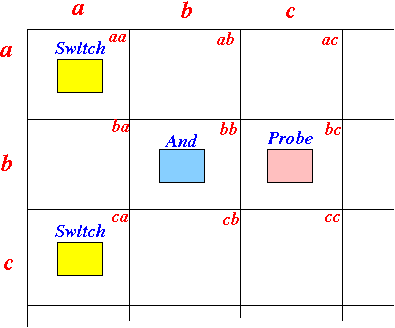
- Example:
     Sig(sw0,1);
     Sig(sw1,1);
     Sig(out,1);

     Switch ( "aa", sw0, 'a', Zero );  // Location = "aa", name = sw0, key = 'a'
     Switch ( "ca", sw1, 'b', One );   // Initial value: Zero or One

     And  ( "bb", (sw0,sw1), out );    // And: inputs = (sw0,sw1), output = out

     Probe ( "bc", out );              // Probe out
Placement of the various components:
- Fact:
- The output of
a component is
connected to
the input of
another component
- You cannot connect the output of a component to the output of another component !!!
- The output of
a component is
connected to
the input of
another component
- Connecting the
output of
a Component1 to the
input of another
Component2:
       Sig(signalX,1);

       Component1( coord1,  ...,  signalX );
                   // SignalX is the output signal of Component1

       Component2( coord2, signalX,  ...  );
                   // SignalX is the input signal of Component2
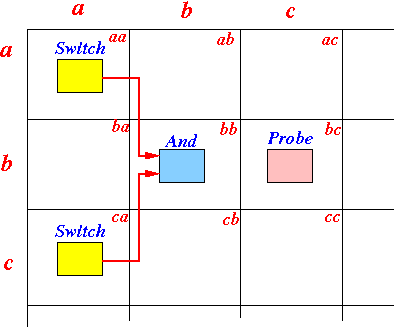
- Example:
     Signal sw0, sw1, out;

     Switch ( "aa", sw0, 'a', Zero );
                    ^^
                    Output signal of a switch

     Switch ( "ca", sw1, 'b', One );
                    ^^
                    Output signal of a switch

     And  ( "bb", (sw0,sw1), out );
                   ^^^^^^^
                   Input signals of the And gate

     Probe ( "bc", out );
Resulting connection made by the red signals:
- Warning:
- You cannot (except in the case of tri-state-buffers) connect the outputs of components together.
- When are
outputs of
different components
connected together:
- The outputs of components are connected together if the signal variable used in the output of the components are the same
Example:
   And  ( "bb", ...., out );    // output = out

   Or   ( "bc", ...., out );    // output = out
- Example Program:
(Demo above code)

- Prog file: click here
How to run the program:
- Right click on link and
save in a scratch directory
- To compile: cs355sim andx
- To run: ./simex
Error message:
- The program will
compile
- When the circuit simulation is
run, you need see this
error message:
   Error (outputConectivityError): Signal[4]  name = UnNamed[0]
     const plus source or two sources, cmp = 3  name = Or at bc
   There are 1 outputConnectivityErrors--Unable to Continue.
- Fact:
- You can use the function key F5 to toggle the display of the signal labels
- Example: run the circuit simulation
in the previous example
Press the function key F5 and you will see the following:

- Note:
- Yo do not want to
display the
signal labels because
you will use
many signals in
your projects
- I tell you this because it will give you some idea on how the circuit simulation works....
- Yo do not want to
display the
signal labels because
you will use
many signals in
your projects
- Grouping (existing) signals
- After defining the
signals:
    Sig(a, 10);   // Signals: a[0], a[1], ........., a[9]
    Sig(b, 5);    // Signals: b[0], b[1], ..., b[4]
you can group some of the signals together:
   ( signal1, signal2, ..., signalN )     = a group of signals


   A group of signal "counts" as ONE single signal !!
This is just like Java:
   {
      Statement1;
      Statement2;       // "Counts" as ONE single statement !!!
      ...
      StatementN;
   }
- After defining the
signals:
- Example:
- The And-gate has the following
syntax:
And( Coord, InputSignal, OutputSignal );
The InputSignal consists of only one signal !!!
- To use
an input of
two signals to
the And-gate, we
group the input signals
as follows:
And ( Coord, ( input1, input2 ), output );
- The And-gate has the following
syntax:
- Example Program:
(Demo above code)
- Prog file: click here
How to run the program:
- Right click on link and
save in a scratch directory
- To compile: cs355sim and
- To run: ./simex
- Fact:
- Often, a group of
signals
is composed of
signals from
different sources
- When we compose
a group of signals,
we often use
a sub-range of signals
from
different sources
- In logic-sim, there is a convenient way to denote sub-range of the signal array.
- Often, a group of
signals
is composed of
signals from
different sources
- Recall:
    Sig( a, 10 );       // Define a range of signals: a[0] ... b[9]
    Sig( b, 5  );       // Define signals: b[0] .. b[4]
- We can compose a
group of signals
using a range notation
x[i]-x[j]
as follows:
   (a[0]-a[3])      means:   a[0], a[1], a[2], a[3]  (4 signals !)
   (a[3]-a[0])      means:   a[3], a[2], a[1], a[0]  (4 signals !)
   (a[0],a[3])      means:   a[0], a[3]              (2 signals !)
   (a[3],a[0])      means:   a[3], a[0]              (2 signals !)
- I will show you an example of range-notation of signals later (in the next webpage) where we discuss how to use the Multiplexor component in the logic simulator