The "ripple carry" adder for binary numbers
|
The full adder circuit
|
Operation of the full adder circuit
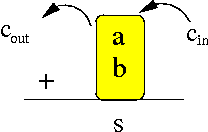
The full adder performs the addition of 2 corresponding bits (a and b) with a carry indication cin:
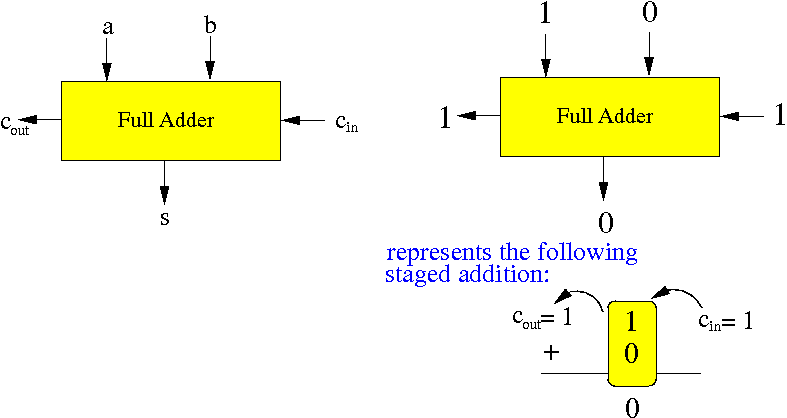
The sum output
s =
the sum result of the
addition of
a, b and
cin
The cout output
= 1 if the
addition produced a
carry (and
= 0 otherwise)
Designing the full adder circuit
The logic table of the full adder circuit is as follows:
        (inputs)      (outputs)
       cin  a   b  |   cout  s
      -------------+----------
       0    0   0  |   0    0
       0    0   1  |   0    1
       0    1   0  |   0    1
       0    1   1  |   1    0
       1    0   0  |   0    1
       1    0   1  |   1    0
       1    1   0  |   1    0
       1    1   1  |   1    1
|
|
We could use the digital circuit design method to construct a (non-optimal) full adder circuit..
The optimal circuit
for a full adder
Because the full adder is a very important circuit, we have found the optimal solution:

DEMO: /home/cs355001/demo/circuits/1-full-adder.m
The ripple carry adder
|
I will now show the design of a ripple carry adder to add binary numbers of (upto) 4 bits
The design can be easily generalized for binary numbers of any number of bits
The ripple carry ader for
binary numbers of (upto) 4 bits
The 4 bits ripple carry adder adds two 4-bits (binary) numbers ( a3a2a1a0 +b b3b2b1b0 ):
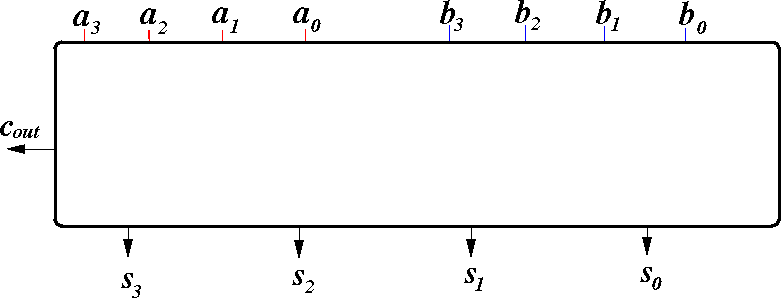
The
sum of the
addition is
s3s2s1s0
And
cout = 1
if the
addition
produced a carry
output
(and cout = 0
otherwise)
The ripple carry ader for
binary numbers of (upto) 4 bits
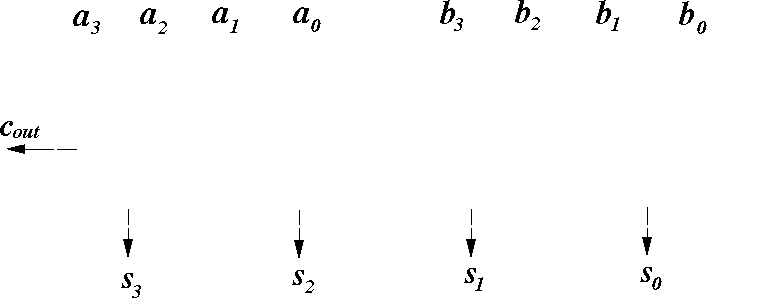
We start with putting down the inputs and outputs of the circuit:
The ripple carry ader for
binary numbers of (upto) 4 bits
Add the last pair of binary digits using one full adder circuit:
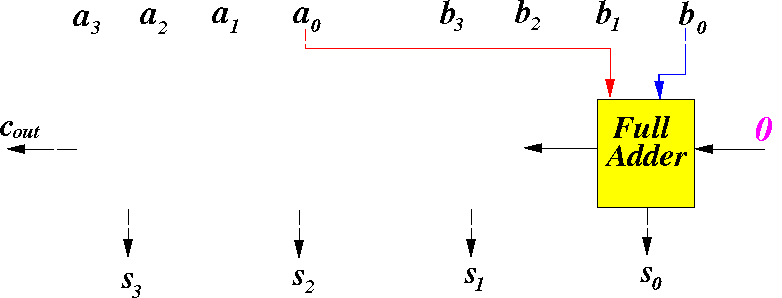
The Carry Input = 0 because there were no previous additions !
The ripple carry ader for
binary numbers of (upto) 4 bits
Then: add the next pair of binary digits using the carry from the previous full adder:
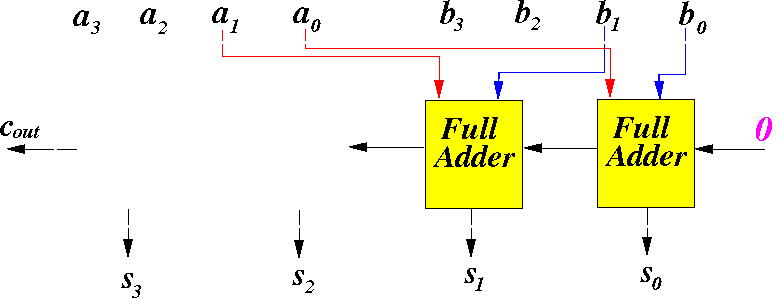
The ripple carry ader for
binary numbers of (upto) 4 bits
Next: add the next pair of binary digits using the carry from the previous full adder:
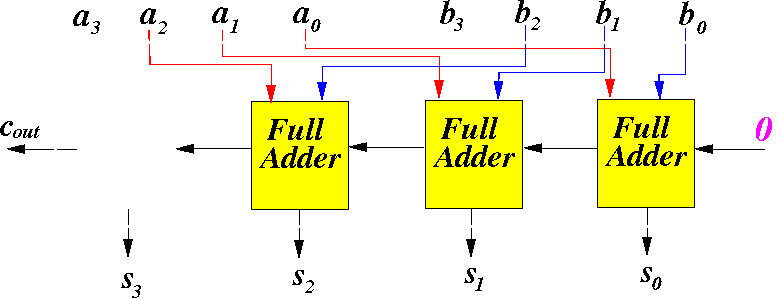
The ripple carry ader for
binary numbers of (upto) 4 bits
Finally: add the last pair of binary digits using the carry from the previous full adder:
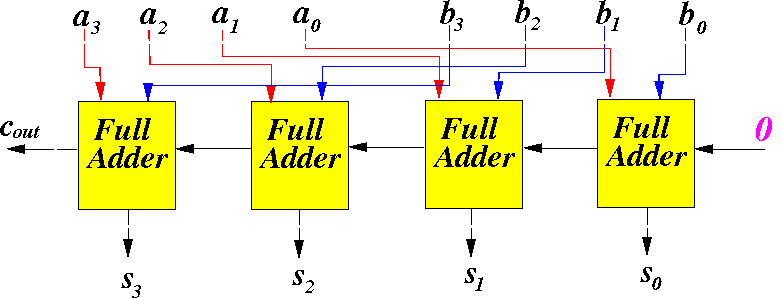
DEMO: /home/cs355001/demo/circuits/4-bit-adder.m
Using a user-defined component to construct
another
user-defined component
|
The constant inputs ZERO and
ONE
in EDiSim
|
The array signal notation in
EDiSim
|
Example using the array signal notation
Previously, you saw the 4-bit-adder circuit in EDiSim code using non-array signal notation:
Define FourBit_Adder a3 a2 a1 a0 b3 b2 b1 b0 | CarryOut s3 s2 s1 s0; Full_Adder ch ZERO a0 b0 | c1 s0; Full_Adder cf c1 a1 b1 | c2 s1; Full_Adder cd c2 a2 b2 | c3 s2; Full_Adder cb c3 a3 b3 | CarryOut s3; Endef; |
It is rather cumbersome to write a long series of digits
Example using the array signal notation
Using the array signal notation of EDiSim, the same circuit can be re-written more succinctly as:
Define FourBit_Adder a[3..0] b[3..0] | CarryOut s[3..0]; Full_Adder ch ZERO a[0] b[0] | c1 s[0]; Full_Adder cf c1 a[1] b[1] | c2 s[1]; Full_Adder cd c2 a[2] b[2] | c3 s[2]; Full_Adder cb c3 a[3] b[3] | CarryOut s[3]; Endef; |
Note that we must change a0 ⇒ a[0], a1 ⇒ a[1], ... b0 ⇒ b[0], b1 ⇒ b[1],... s0 ⇒ s[0], s1 ⇒ s[1],... inside the body of the definition !!!
(Because: a0 ≠ a[0], a1 ≠ a[1], ... b0 ≠ b[0], b1 ≠ b[1],... s0 ≠ s[0], s1 ≠ s[1],... !!!)
DEMO: /home/cs355001/demo/circuits/4-bit-adder.arr