
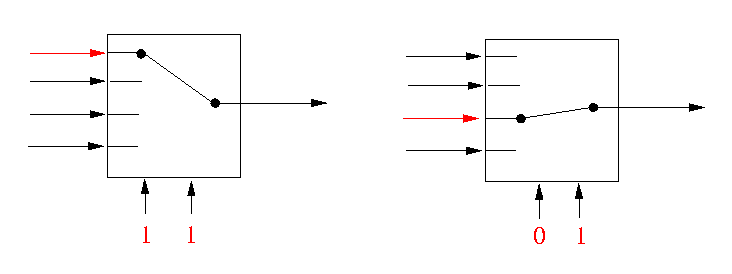
The above figure shows the logical function of a many-to-one switch in 2 different state. In the left figure, the switch directs the top-most input to the output, and in the second, it directs the 3rd input to the output.
One example is the switch in a boom box that let you select from CD, radio, and cassete.
Schematically (functionally), a multiplexor looks like this:
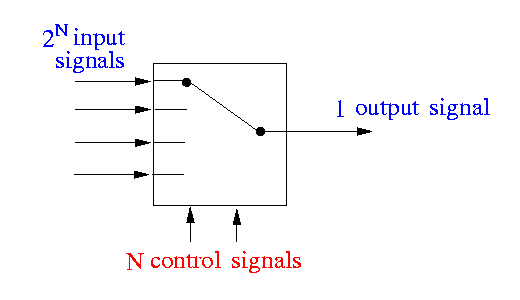
- It has 2N input signals
- It has N control signals
- It has 1 output signal
- The output signal is equal to one of the input signal depending on the current value of the control signals.
Examples:
- In the first stage, we use 2N and gates to filter out the desired input signal.
- The and-gates must be connected in such a way that for any given combination of control signal, only the desired input signal is switch out, while all other input signal is cut off.
- In the second state, we use one or gate to collect all the outputs from the and-gates.
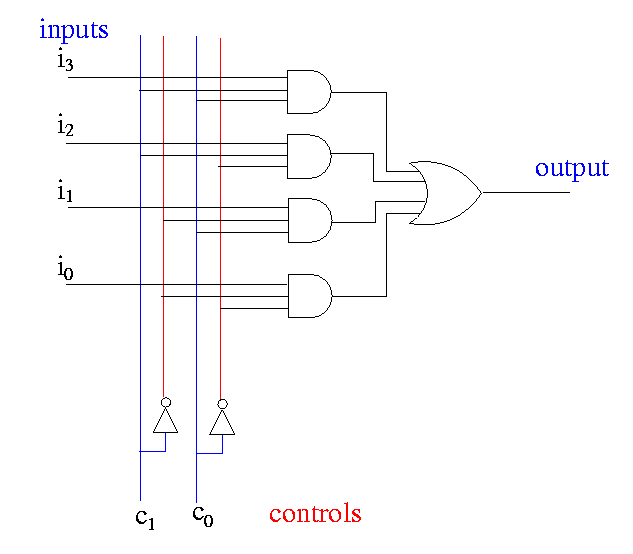

- Notice that three of the and gates will receive at least one input that is equal to ZERO (red line). These and-gates will output ZERO.
- Notice that the top-most and gates will receive all 1's from the control-inputs. The top-most and-gate will operate as a "pass-through" for the input signal i3
- The output of the top-most and-gate is equal to the input value i3
- Looking at the Or-gate, you will notice that all but one input is ZERO (because all but one and-gates in the first stage will output ZERO).
- The or-gate will thus also operate as a "pass-through" for the input signal i3
- The first example defines a mux circuit with the following
input/output paremeters:
click here
     void MyMux ( const SD &sd, const Signal &in, const Signal &out)
     {
        ...
     }
It works, but the control signals and data signals are mixed together as in[] and you have a hard time remembering how each input signal is used.
- The second example defines a mux circuit with the following
input/output paremeters:
click here
     void MyMux ( const SD &sd, const Signal &c, const Signal &in, const Signal &out)
     {
        ...
     }
Notice that the method has 2 different set of input signals: c[] and in[].
The control signals and data signals are separated and you have much a easier time remembering how each input signal is used.
You invoke the MyMux with 4 parameters:
   /* =======================================================
      You need to pass the control signals and input signals
      as different parameters
      ======================================================= */
   MyMux ( "1b-4d", (co1, co0), (in3, in2, in1, in0), out );
//                   ^^^         ^^^
//                   Pass in the control and input signals separately
- In the last example, I show you how to use the
built-in
multiplexor component
in logic-sim:
click here
Mux ( "ab-db", (sw7,sw8), (sw3,sw2,sw1,sw0), out );
(which is identical to the second example).