First, what is the state of the computer:
- MPC contains 0
- The PC register will contain the address of the memory that
contains the next assembler instruction to be executed.
(Note: when you first turn on the computer, PC will be reset to 0)
- IR does not contain any useful information
- The memory contains the program
The first step that the CPU must perform is to fetch the data at address given by the PC register from memory and store it in the IR register.
| Register | Name | Usage |
|---|---|---|
| R0 | Program Counter (PC) | Holds address of next instruction |
| R1 | Accumulator (AC) | Main working/scratch register |
| R2 | Stack pointer (SP) | Points to top of stack |
| R3 | Instruction Register (IR) | Holds currect instruction |
| R4 | Temp Instruction Register (TIR) | Use to decode instruction |
| R5 | 0 (ZERO) | Hardwired Constant (like g0 in SPARC) |
| R6 | +1 (ONE) | Hardwired Constant (like g0 in SPARC) |
| R7 | -1 (MINUS ONE) | Hardwired Constant (like g0 in SPARC) |
| .. | .... | ... |
ADDR   Micro Assembler Instruction                      Comment
===========================================================================
 0:    mar := pc; rd;                                   {main loop}
 1:    pc := pc + 1; rd; mbr;                           {increment pc, MBR}
 2:    ir := mbr; if n then goto 31;                    {save, decode mbr}
 3:    tir := lshift(ir + ir); if n then goto 22;
 4:    tir := lshift(tir); if n then goto 13;           {000x or 001x?}
 5:    alu := tir; if n then goto 9;                    {0000 or 0001?}
       ....
- MPC = 0, so the datapath fetches and executes
mar := pc; rd;
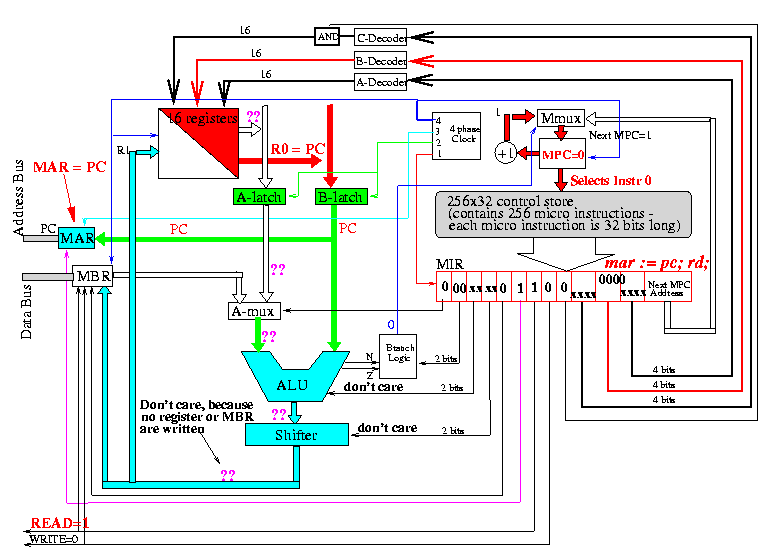
After running the 4-phase clock from phase 1 to phase 4, the datapath would have performed the following:
- Address in the PC register is copied into MAR and sent out on the address bus
- A READ operation is started
- In other words: fetch the data at memory location given by PC !
- Cond code = 00 will update MPC = 1 (0 + 1), and next micro-instruction fetched (and executed by the datapath) is at address 1.
- Now MPC = 1, so the datapath fetches and executes
pc := pc + 1; rd; mbr;
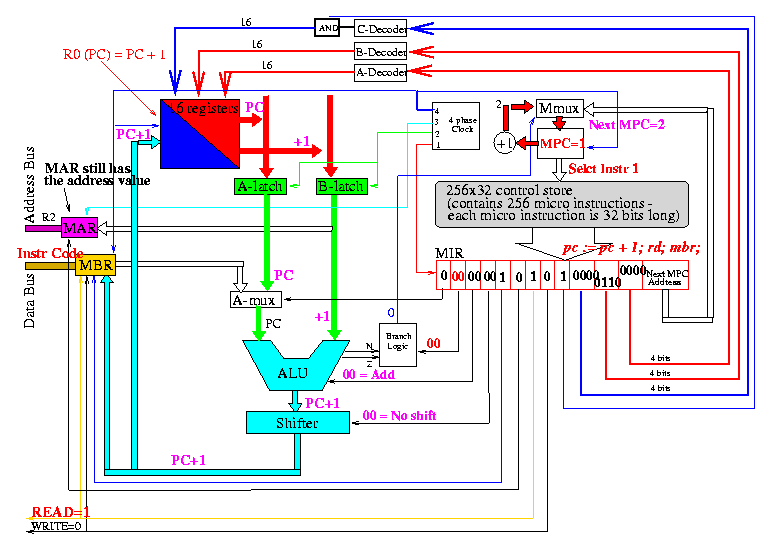
After running the 4-phase clock from phase 1 to phase 4, the datapath would have performed the following:
- Update PC = PC + 1 (PC register now points to the next assembler instruction in memory)
- The READ operation is continued and during phase 3,
the data on the databus will be copied into the MBR
(because the mbr bit is set !)
- In other words: the instruction memory location given by PC is now copied into the MBR
- The cond code = 00 will update MPC = 2 (1 + 1), and next micro-instruction fetched (and executed by the datapath) is at address 2.
- Now MPC = 2, so the datapath fetches and executes
ir := mbr; if n then goto 31;
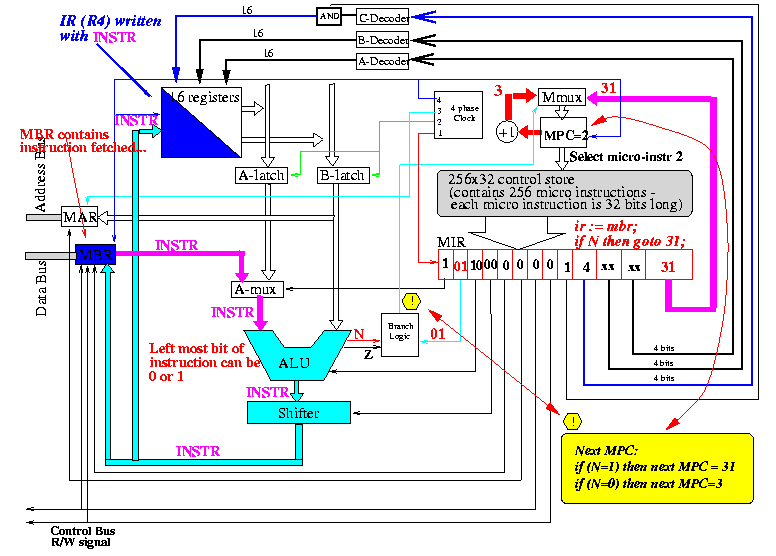
After running the 4-phase clock from phase 1 to phase 4, the datapath would have performed the following:
- Copy the data from MBR into the IR register
- In other words: the instruction memory location given by PC is now copied into the IR register
- The instruction at PC has been fetched !!!
- The ALU's output is equal to the code in the assembler instruction and the N-flag is equal to the left most bit in the assembler instruction.
- The cond code = 01 and the value of the ALU's N bit
will:
- update MPC = 3 (2 + 1) if the left most bit of the assembler instruction = 0.
- update MPC = 31 (branch addr) if the left most bit of the assembler instruction = 1.
- Copy the data from MBR into the IR register
-
After executing the first 3 micro-instructions in the micro-program,
we have achieved the following:
- Fetched the instruction in memory at address given by the PC register
into the IR register
- Incremented PC to point the the next instruction
(prepare for the next instruction execution cycle)
- The MPC = 3 if the left most bit in the instruction = 0 and the MPC = 31 if the left most bit in the instruction = 1.

- Run: /home/cs355000/bin/cs355-demo-computer
Do the following:
- Press I, then press r
- Maximize the window
- Toggle key 1 TWICE - this resets the computer
- Toggle key 1 REPEATED and you will see this:
- CPU sends address 0 to memory
- Memory returns the instruction at address 0 (which is: 0000000000001010)
- This instruction is store in IR (R3 - the 4th register)