- When program P1 performs an IO operation that causes the program to become not ready, the OS stops the program by saving its context in the corresponding PCB structure variable, removes the program from the Ready Queue, puts it in the DMA device queue and then resume with another ready program
But as soon as the DMA has completed the IO transfer operation, the program P1 is again ready (because it can then continue with its execution without causing any errors).
Therefore, as soon as the DMA has completed the IO transfer operation, the PCB of program P1 (which can be found in the DMA queue), must be removed from the DMA queue and insert back into the Ready Queue (so that it can (re)claim the use of the CPU).
Well, one simple solution is to have the CPU read the status register of the DMA from time to time to see if the DMA has become idle.
But this apporach is inferior to the commonly used solution that uses interrupt signals
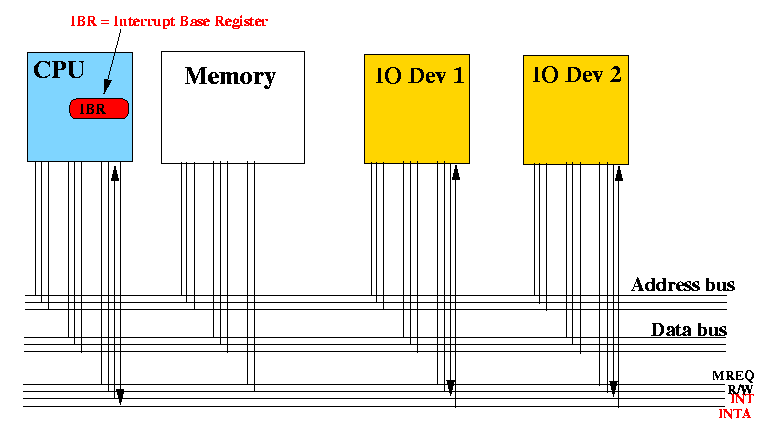
The complete instruction execution cycle is as follows:
- Fetch (assembler) instruction from memory at address PC and increment PC (to point to the next instruction)
- Decode instruction fetched.
- Fetch operands needed to execute the instruction
- Execute the instruction
- Check for interrupt signal(s)
- I will assume that there is only one IO device
(controled by 1 DMA).
- The Interrupt Base Register IBR contains the starting of a routine and from the description above, the CPU will make a (unprogrammed) subroutine call to this routine when the DMA raises the interrupt.
cc interrupt.c
and run it using:
a.out
The main loop looks like this:
   while (1)
   {
      for (i = 0; i < 999999; i++);   // Slows the program down a bit...

      putchar('.');            // Print "."
      fflush(stdout);          // Make sure the character is displayed
   }
If you run the program, it will print:
.................................................
.................................................
.................................................
.................................................
and so on....
You can force this program to make a "unprogrammed" function call to the function Int_Handler by typing Control-C. It will print the text:
Hello, I'm your firendly interrupt handler. Times called: 0and then return to the while loop and continue to print ".". You can force it to call Int_Handler over and over again, but typeing Control-C.
Recall the situation prior to the completion of the IO operation:

Make sure you understand what you want to achieve:
- The IO transfer initialized by Program P1 has completed.
- So program P1 has become ready
- We need to move program P1's PCB back to the Ready Queue
Recall that the CPU will make an "unprogrammed" subroutine call to the memory location given by the IBR when the CPU detects an interrupt.
The following picture depicts the "reclaim the CPU" solution:
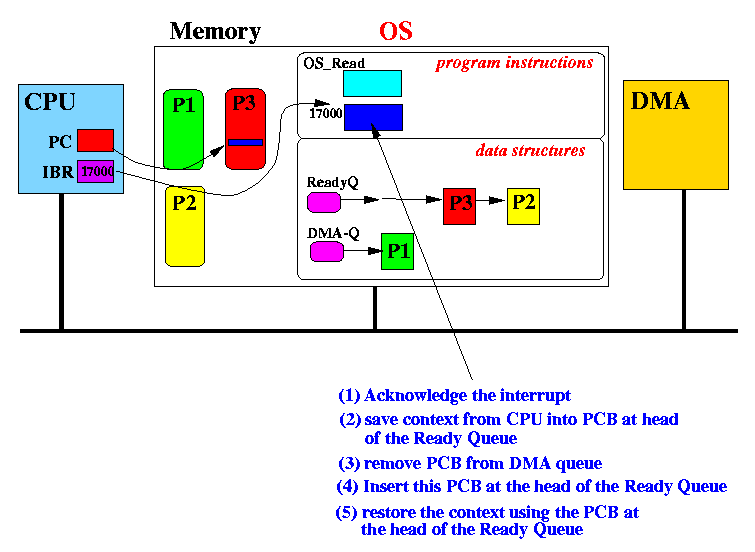
While program P3 was running on the CPU (i.e., CPU fetches and executes instructions from program P3), the DMA completes the data transfer operation. When the DMA finishes the IO transfer, it will raise the interrupt signal. The sequence of events that follows is:
- CPU finishes executing an instruction from program P3
- CPU detects the interrupt signal, as a result, makes an subroutine
call to the address given by IBR (in this example, IBR = 17000,
so CPU runs the subroutine at 17000)
- The subroutine at 170000 is given in the figure.
The subroutine will contain program instructions
that instruct the CPU to do the following:
- CPU sends out the INTA
(Interrupt Acknowledge) signal - there is an assembler instruction
"IA" that instruct the CPU to do this (not covered in CS255
because there was no need to then).
- Save the context information from the CPU (register, PC and PSR)
into the PCB at the head of the ready queue.
- Move the PCB from the DMA queue back into the ready queue
(the PCB pertains to the program that requested the DMA IO operation,
now that the DMA is finished, this program has become ready.
So it is only proper to move the PCB back to the ready queue
where it now belongs).
Usually, the PCB from the DMA queue is inserted at the head of the ready queue. So the PCB of program P1 will be at the head of ready queue after this step.
- Finally: restore the context from the head of the ready queue.
Because the PCB of program P1 is at the head of the ready queue, the program P1 will be resumed.
- CPU sends out the INTA
(Interrupt Acknowledge) signal - there is an assembler instruction
"IA" that instruct the CPU to do this (not covered in CS255
because there was no need to then).