- The ALU instruction data hazard is caused by
some ALU instruction producing new values for
a register and that register was not updated immediately,
- The solution is to make the new value available to the next
instruction using a "feedback" circuitry.
- The technique used is similar to one found in caches
- Let us first examine the hardware needed to solve the ALU instruction data hazard:

We need to add the following circuits:
- Two registers (made with D-flipflops) called FR1 and FR2.
The registers are called Forwarding Registers
because they will be used to forward fresh values
to the ALU.
The input of ForwReg1 is tied to the output of the ALU,
The input of ForwReg2 is tied to the output of ForwReg1,
So: ForwReg1 will contains the value of the current ALU instruction and ForwReg2 contains the value of the one before the current instruction.
- Associated with each Forwarding register is a tag register.
The tag register records the register number associated
with the Forwarding Register (indicates which register the
values belongs to)
The input of tag register 1 is the destination field of the instruction (this field contains the register number that will receive the value)
- The Multiplexor in the EX stage is augmented.
The first multiplexor (yellow one) will select from among: PC1, A, ForwReg1 and ForwReg2.
The selection logic of this multiplexor is as follows:
   if ( Instruction == Branch )
      select PC1 as operand
   else if ( tag1 == Src1 )
      select ForwReg1 as operand
   else if ( tag2 == Src1 )
      select ForwReg2 as operand
   else
      select A as operand
The reason for this should be clear:
- A branch instruction does not use any registers to compute the target
addres and will need to use PC1 as first operand, so
we select PC1 when the instruction is "branch"
- When we have an ALU, Load or Store, we need to be careful where we
get the operand from.
If the register where we get the operand is the register updated by the last instruction (that is when ( tag1 == Src1 ), we use the value stored in the ForwReg1 as operand.
If the register where we get the operand is not the register updated by the last instruction but was updated by the instruction before the last instruction (that is when ( tag2 == Src1 ), we use the value stored in the ForwReg2 as operand.
If neither case hold, we can use the value fetched from the register without any problem.
The second multiplexor (gold colored one) will select from among: IR1 (a constant), B, ForwReg1 and ForwReg2.
The selection logic of this multiplexor is as follows:
   if ( Instruction Imm bit is set to 1 )
      select IR1 as operand
   else if ( tag1 == Src2 )
      select ForwReg1 as operand
   else if ( tag2 == Src2 )
      select ForwReg2 as operand
   else
      select B as operand
The reason for this is similar to the first case:
- An instruction that has the Imm bit set
will use a constant as the second operand, so
we select IR1 as operand when the Imm bit is set to "1"
- When we have an ALU, Load or Store, again, we need to be careful
where we get the operand from.
If the register where we get the operand is the register updated by the last instruction (that is when ( tag1 == Src2 ), we use the value stored in the ForwReg1 as operand.
If the register where we get the operand is not the register updated by the last instruction but was updated by the instruction before the last instruction (that is when ( tag2 == Src2 ), we use the value stored in the ForwReg2 as operand.
If neither case hold, we can use the value fetched from the register without any problem.
- A branch instruction does not use any registers to compute the target
addres and will need to use PC1 as first operand, so
we select PC1 when the instruction is "branch"
Let us first look at an example and convince ourselves that the solution works. Later, I will should you how the two multiplexor in the EX stage is constructed (it's pretty straightforward).
- Reconsider the following program that is executed by the IMPROVED
pipeline:
   ADD R2, R3, R1            R2=11, R3=9, R4=1, R5=8, R6=0, R7=2
   ADD R4, R1, R4
   ADD R5, R1, R5
   ADD R6, R1, R6
   ADD R7, R1, R7
   ...
- The correct behavior (one that an assembler programmer would expect) is: R1 := R2+R3 = 20, then the other instructions will add R1=20 to registers R4 (20+1), R5 (20+8), R6 (20+0) and R7
- At start of the CPU cycle, the IF stage sends out PC
- At end of the CPU cycle, the IR(ID) register is updated with the instruction fetched (ADD R2, R3, R1)

- The picture above depicts the content of the CPU at end of the first CPU cycle (and the start of the 2nd cycle) - nothing special happened....
- At start of the CPU cycle, the ID stage sends out selection
signal that selects values from R2 and R3
- At end of the CPU cycle, A register is updated with R2 = 11,
B register is updated with R3= 9.
- Also, at the end of the CPU cycle, the instruction (ADD R2, R3, R1) is moved into IR(EX) and instruction ADD R4, R1, R4 is fetched into IR(ID)

- The picture above depicts the content of the CPU at end of the second CPU cycle (and the start of the 3rd cycle) - still nothing special happened....
- At start of the CPU cycle, the EX stage selects
values from R2 and R3 for the ALU, use the ALU opcode
to make ALU add the input values forming the result 20
(which will become the value of R1)
The difference now is the result (20) will also be written into the Forwarding Register 1 along with the register tag = 001 (indicating register R1)
Also, at start of the CPU cycle, the ID stage selects R4 and R1 to be copied into the A and B registers,
Notice that an OLD value of R1 will still be fetched into B. (That is not a problem because we will find a way to obtain the more recent value from the forwarding registers - see next CPU cycle).

- The picture above depicts the content of the CPU at end of the 3rd CPU cycle (and the start of the 4th cycle)
- Something special is about to happen.... But first: note in the above picture that the NEW value (20) of R1 is one of the inputs of the Multiplexor (see the red line) along with the old value of R1 (see the magenta line).
- At start of the CPU cycle, the EX stage
will apply the new selection logic to select the operand
( click here )
Notice that the Src2 field in "ADD R4, R1, R4" contains the bits 001 to indicate R1 !!!
For the first operand, the value from the A register (R4) is selected.
For the first operand, the value of the Forwarding register 1 is select -- because (tag1 (001) == Src2 (001)).
So the ALU will add R4 with the NEW value 20 for R1 (which has not arrived to R1 yet !!!)
Pictorially:

- At the end of the cycle, ALUo will be updated with 20+1 = 21,
which is the CORRECT outcome because R1 will be equal to 20).
- Also at the end of the cycle, the value in the Forwarding Register 1
is copied (preserved for one more CPU cycle) to
Forwarding Register 2.
- At the end of the cycle, the result of the ALU (21) is copied into Forwarding Register 1 along with the register tag "100" indicating register R4 - this Forwarding Register value will aid in "correcting" a subsequent instruction that use R4 as a source operand !!!

- The picture above depicts the content of the CPU at end of the 4th CPU cycle (and the start of the 5th cycle)
- Note in the above picture that the NEW value (20) of R1 is still available in Forwarding Register 2 as one of the inputs of the Multiplexor (see the red line) along with the old value of R1 (see the magenta line).
- Now you should understand why we need two forwarding registers cascaded one after the other. The register value R1 is retained for exactly 2 CPU cycles, because we have previously determined that 2 instructions fails to obtain the more recent value.
- At start of the CPU cycle, the EX stage
will apply the same new selection magic - oops, I meant "logic"
to select the operand
( click here )
Notice that the Src2 field in "ADD R5, R1, R5" contains the bits 001 to indicate R1 !!!
For the first operand, the value from the A register (R5) is selected.
For the first operand, the value of the Forwarding register 2 is select -- because (tag2 (001) == Src2 (001)).
So the ALU will add R5 with the NEW value 20 for R1 (which has still not arrived to R1 yet !!!)
Pictorially:

- At the end of the cycle, ALUo will be updated with 20+8 = 28,
which is the CORRECT outcome because R1 will be equal to 20).
- Also at the end of the cycle, the value in the Forwarding Register 1
is copied (preserved for one more CPU cycle) to
Forwarding Register 2.
So now the value of R1 is lost !!!
NOTE: That is not a problem because we have previously determined that the 3rd instruction following "ADD R2,R3,R1" is able to obtain the correct value straight from R1.
- At the end of the cycle, the result of the ALU (28) is copied
into Forwarding Register 1 along with the register tag "101"
indicating register R5 -
this Forwarding Register value will aid in "correcting" a subsequent
instruction that use R5 as a source operand (while the
value in Forwarding Register 2 is used to correct instructions
that use R4 as source operand) !!!

- The picture above depicts the content of the CPU at end of the 4th CPU cycle (and the start of the 5th cycle)
- Note in the above picture that the NEW value (20) of R1 is still available in Forwarding Register 2 as one of the inputs of the Multiplexor (see the red line) along with the old value of R1 (see the magenta line).
- Now you should understand why we need two
forwarding registers cascaded one after the other.
The register value R1 is retained for exactly 2 CPU cycles,
because we have previously determined that 2 instructions
fails to obtain the more recent value.
- The multiplexor used in the data forwarding technique must
implement a "if-else" selection algorithm and
must compare binary values in the process.
- The following circuit can be used to compare 2 binary number
and determine if they are equal:
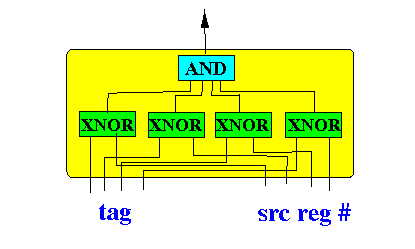
- XNOR (Exclusive NOR)
will output ONE if and only if the both input bits are equal
- The circuit will output ONE if and only if ALL pairs of bits are equal....
- XNOR (Exclusive NOR)
will output ONE if and only if the both input bits are equal
- This equality circuit is used with a number of multiplexors
to construct the "if-else" selection algorithm in hardware.
- The following circuit diagram shows the multiplexor for the first
input of the ALU (the yellow multiplexor):

- Notice that the last multiplexor will affect the input most, and this mux selects PC1 for the branch and some other value. The PC1 value is selected when the instruction is a BRANCH instruction
- The following figure shows how the connection is made to the
Forwarding registers:

- The figure should be self-explanatory if you follow the above discussion....