- OpenMP is a portable, parallel programming model
for shared memory multiprocessor architectures,
developed in collaboration with a number of computer vendors.
- OpenMP API are available for C/C++
(and Fortran)
- For more information on the OpenMP developer community, including tutorials and other resources, see their web site at: http://www.openmp.org
- OpenMP programs are ordinary Fortran or C/C++ proograms
that include
compiler INSTRUCTIONS (directives)
to tell the Fortran or C/C++ compiler to generate parallel
execution code (using threads)
-
Syntax of OpenMP compiler directive for C/C++ compilers:
- Program statements between the { and } are executed by multiple threads
#pragma omp parallel [Options...] { ... ... Parallel region ... ... Program statements between the braces ... are executed in parallel by all threads ... } - The number of threads that will be created to execute parallel sections is controlled by the environment variable OMP_NUM_THREADS
- C/C++
- Compile: CC -O -c
-xopenmp
Prog.C
- Link: CC -O -o Executable -xopenmp Prog1.o Prog2.o ....
- Compile: CC -O -c
-xopenmp
Prog.C
- Before I continue, I like to show you an example of
an Open MP program so you have some idea what Open MP
can do for you....
-
Example Program:
(OpenMP Hello World) ---
click here

- Compile with:
-
CC -xopenmp openMP01.C
- Run with:
export OMP_NUM_THREADS=8
a.outYou will see "Hello World !!!" printed EIGHT times !!! (Remove the #pragma line and you get ONE line)....
#include<opm.h> int main(int argc, char *argv[]) { #pragma omp parallel { cout << "Hello World !!!" << endl; } } -
Example Program:
(OpenMP Hello World) ---
click here
- What is happening in an OpenMP program ?
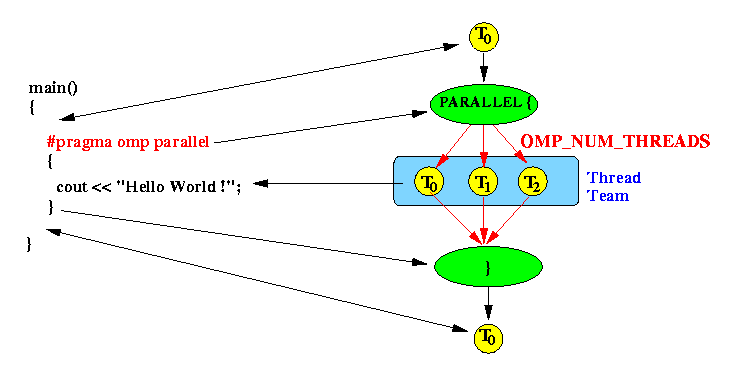
- Before the directive #pragma omp parallel
the program is single-threaded
- this thread is also known as
the
MASTER THREAD
- The directive #pragma omp parallel
tells the compiler to create a thread team.
The number of threads in the team is determined by
the environment variable
OMP_NUM_THREADS
- At the end of the parallel section,
ALL threads
are
implicitly joined
(i.e., the master thread calls "pthread_join" on all worker threads)
Then the master thread T0 continue with the single-threaded execution following the PARALLEL section.
- Before the directive #pragma omp parallel
the program is single-threaded
- this thread is also known as
the
MASTER THREAD
- So in essence, an OpenMP program is nothing more than a
multi-threaded program that you have seen
when we discussed pthreads
- Just like in pthreads, there are 2 different kinds
of variables:
- Shared variables
where a single copy of the variable exists
and all threads access that single copy
- Private variables where a copy exists for each thread and each thread accesses its own copy of that variable.
- Shared variables
where a single copy of the variable exists
and all threads access that single copy
- How to tell which variables are shared/private
- Variables
without any directives
that are
defined OUTSIDE the scope of a parallel region
but are visible
inside the scope
of a parallel region are
by default SHARED
- Variables without any directives that are defined INSIDE the scope of a parallel region are NON-SHARED (only possible is languages with scoping rules - C/C++)
- Variables
without any directives
that are
defined OUTSIDE the scope of a parallel region
but are visible
inside the scope
of a parallel region are
by default SHARED
- C/C++ example of SHARED variable:
-
Example Program:
(Shared variable in OpenMP) ---
click here
- Compile with: CC -xopenmp openMP02a.C
- Run with: export OMP_NUM_THREADS=8; a.out (make sure you run on compute.mathcs.emory.edu - an 8-way multi-processor)
You should see the value for N at the end is not always 1009, it could be less. You have seen this phenomenon before in threaded programs when multiple-threads update a shared variable concurrently... The same things is happening here.
 #include <omp.h>

 int main(int argc, char *argv[])
 {
   int N;      // Variable defined OUTSIDE parallel region....
	       // It is therefore SHARED

   N = 1001;

   cout << "Before parallel section: N = " << N << endl;

   #pragma omp parallel
   {
      N = N + 1;
      cout << "Inside parallel section: N = " << N << endl;
   }

   cout << "After parallel section: N = " << N << endl;
 }
-
Example Program:
(Shared variable in OpenMP) ---
click here
- C/C++ example of NON-SHARED (private) variable:
-
Example Program:
(Shared variable in OpenMP) ---
click here
- Compile with: CC -xopenmp openMP02b.C
- Run with: export OMP_NUM_THREADS=8; a.out (make sure you run on compute.mathcs.emory.edu - an 8-way multi-processor)
You should see the value for N at the end is not always 1009, it could be less. You have seen this phenomenon before in threaded programs when multiple-threads update a shared variable concurrently... The same things is happening here.
#include <omp.h> int main(int argc, char *argv[]) { #pragma omp parallel { int N; // Variable defined INSIDE parallel region.... // It is therefore NON-SHARED N = 1001; N = N + 1; } // ERROR if you try to do this: // cout << "N = " << N << endl; // because N is not defined in the outer scope !!! } -
Example Program:
(Shared variable in OpenMP) ---
click here
- In addition to compiler directives (pragmas),
there are a number of support functions in OpenMP:
Function Name Effect omp_set_num_threads(int nthread) Set size of thread team INTEGER omp_get_num_threads() return size of thread team INTEGER omp_get_max_threads() return max size of thread team (typically equal to the number of processors INTEGER omp_get_thread_num() return thread ID of the thread that calls this function INTEGER omp_get_num_procs() return number of processors LOGICAL omp_in_parallel() return TRUE if currently in a PARALLEL segment omp_init_lock(omp_lock_t *lock) Initialize the mutex lock "lock" omp_set_lock(omp_lock_t *lock) Lock the mutex lock "lock" omp_unset_lock(omp_lock_t *lock) Unlock the mutex lock "lock" omp_test_lock(omp_lock_t *lock) Return true if the mutex lock "lock" is locked, returns false otherwise - Here is a simple OMP program in C++:
#include <iostream.h> #include <omp.h> // Read in OpenMP function prototypes int main(int argc, char *argv[]) { int nthreads, myid; #pragma omp parallel private (nthreads, myid) { /* Every thread does this */ myid = omp_get_thread_num(); cout << "Hello I am thread " << myid << endl; /* Only thread 0 does this */ if (myid == 0) { nthreads = omp_get_num_threads(); cout << "Number of threads = " << nthreads << endl; } } return 0; } -
Example Program:
(OpenMP C++ program) ---
click here
- Compile using the following command:
- CC -xopenmp hello.C
- Compile using the following command:
- We have seen a program to
find the minimum value
in an array before
( click here )
- We will
write the same program - but using the OpenMP pragmas - The structure of the program is as follows:
   /* Shared Variables */
   double x[1000000];   // Must be SHARED (accessed by worker threads !!)
   int    start[100];   // Contain starting array index of each thread
   double min[100];     // Contain the minimum found by each thread
   int    num_threads;

   int main(...)
   {
      for (i = 0; i < MAX; i++)
         x[i] = random()/(double)1147483648;

      // ---------------------------------------------------
      // Tell each thread where to start searching for min
      // ----------------------------------------------
      for (i = 0; i < num_threads; i = i + 1)
         start[i] = i;

      #pragma omp parallel
      {
         ... Thread i finds its minimum and
	 ... store the result in min[i]
      }

      // ----------------------------------------
      // Post processing: Find actual minimum
      // ----------------------------------------
      my_min = min[0];

      for (i = 1; i < num_threads; i++)
         if ( min[i] < my_min )
            my_min = min[i];
   }
- The code of the parallel region is as follows:
/* Shared Variables */ double x[1000000]; // Must be SHARED (accessed by worker threads !!) int start[100]; // Contain starting array index of each thread double min[100]; // Contain the minimum found by each thread int num_threads; int main(...) { for (i = 0; i < MAX; i++) x[i] = random()/(double)1147483648; #pragma omp parallel { int id; int i, n, start, stop; double my_min; n = MAX/omp_get_num_threads(); // step = MAX/number of threads. id = omp_get_thread_num(); // id is one of 0, 1, ..., (num_threads-1) start = id * n; if ( id != (num_threads-1) ) { stop = start + n; } else { stop = MAX; } my_min = x[start]; for (i = start+1; i < stop; i++ ) { if ( x[i] < my_min ) my_min = x[i]; } min[id] = my_min; // Store result in min[id] } // ---------------------------------------- // Post processing: Find actual minimum // ---------------------------------------- my_min = min[0]; for (i = 1; i < num_threads; i++) if ( min[i] < my_min ) my_min = min[i]; }- Example Program: (Demo above code)
- Prog file: click here
Compile with:
-
CC -O -xopenmp openMP_compute_pi.C
Run with (on compute):
export OMP_NUM_THREADS=8
a.out - The structure of the program is as follows:
- There are a number of synchronization methods in OpenMP,
but for this short intro, I will limit to one:
mutual exclusion.
- Recall that concurrent updates to shared variables
must be done within a pthread_mutex_lock
and pthread_mutex_unlock pair.
- This mutual exclusion effect is achieved in OpenMP using the
following pragma:
 #pragma omp critical
 {
   ...
   ... Update share variables
   ...
 }
- Consider the following sequential
program that estimate Pi by integrating
2.0 / sqrt(1 - x*x):
-
Example Program:
(Sequential program for Pi) ---
click here
Compile with:
-
CC -O compute_pi.C
Run the program with:
-
a.out NumberOfIntervals
(We have seen this program before, so I will not explain it again: click here )
- We will parallelize the for-loop using OpenMP
 double f(double a)
 {
   return( 2.0 / sqrt(1 - a*a) );
 }


 int main(int argc, char *argv[])
 {
   int    i;
   int    N;
   double sum;
   double x, w;

   N = ...;  // accuracy of the approximation
   w = 1.0/N;

   sum = 0.0;

   for (i = 1; i <= N; i = i + 1)
   {
      x = w*(i - 0.5);
      sum = sum + w*f(x);
   }

   cout << sum;
 }
-
Example Program:
(Sequential program for Pi) ---
click here
- Parallel Open MP program to estimate Pi in C/C++:
When we parallelize, it is important to know which UPDATES must be SYNCHRONIZED:
- When a variable is updated by different threads, the various updates must be synchronized
- Updates that need to be synchronized:
- The only variable that are updated by different threads is:
sum
- So updates to sum must be synchronized.
- The only variable that are updated by different threads is:
sum
- First Version of the OpenMP program to compute Pi:
-
Example Program:
(First version of OpenMP to compute Pi) ---
click here
- Compile with:
-
CC -O -xopenmp openMP_compute_pi-1.C
- Run with:
export OMP_NUM_THREADS=8
a.out 50000000Change OMP_NUM_THREADS and see the difference in performance
 double f(double a)
 {
   return( 2.0 / sqrt(1 - a*a) );
 }


 int main(int argc, char *argv[])
 {
   int    N;
   double sum;   // Shared variable, updated !
   double x, w;

   N = ...;  // accuracy of the approximation
   w = 1.0/N;

   sum = 0.0;

 #pragma omp parallel
 {
   int i, num_threads;    // Non-shared variables !!!
   double x;

   num_threads = omp_get_num_threads() ;

   for (i = omp_get_thread_num(); i < N; i = i + num_threads)
   {
      x = w*(i + 0.5);

      #pragma omp critical
      {
         sum = sum + w*f(x);
      }
   }
 }

   cout << sum;
 }
-
Example Program:
(First version of OpenMP to compute Pi) ---
click here
- Problem with the first version:
- Too many synchronizations operations !!!
- Notice that the CRITICAL
pragme is
INSIDE
the for-loop
- Too many synchronizations operations !!!
- To eliminate
synchronizations,
we use
private variables
- Improved Version of the OpenMP program to compute Pi:
-
Example Program:
(OpenMP compute Pi) ---
click here
- Compile with:
-
CC -O -xopenmp openMP_compute_pi-2.C
- Run with:
export OMP_NUM_THREADS=8
a.out 50000000Change OMP_NUM_THREADS and see the difference in performance
double f(double a) { return( 2.0 / sqrt(1 - a*a) ); } int main(int argc, char *argv[]) { int N; double sum; // Shared variable, updated ! double x, w; N = ...; // accuracy of the approximation w = 1.0/N; sum = 0.0; #pragma omp parallel { int i, num_threads; double x; double mypi; // Private variable to reduce synchronization num_threads = omp_get_num_threads() ; mypi = 0.0; for (i = omp_get_thread_num(); i < N; i = i + num_threads) { x = w*(i + 0.5); mypi = mypi + w*f(x); } #pragma omp critical { sum = sum + mypi; } } cout << sum; } -
Example Program:
(OpenMP compute Pi) ---
click here
- So far, what you have seen is exactly what is achieved using
parallel exeuction with threads
- The PARALLEL is the most basic construct in
OpenMP (every thread executes the code within the
PARALLEL construct.
- There are other more convenient PARALLEL constructs
that help you write parallel programs with more ease
- Here is a list of all PARALLEL (work-sharing)
constructs in OpenMP:
- Parallel loop (DO or for)
- Parallel section
- General work-sharing (Fortran only)
- I will only discuss the PARALLEL LOOP construct because that is where the most common opportunity for speeding up a program.
- From what you have seen so far, you can conclude that
for-loops is a great place to speed up
a program through concurrent execution.
It is a very simple and mechanical process to divide up the work over a number of threads simply by scheduling a different thread to work on the for-body using a different index value.
The division of labor (splitting the work of a for-loop) of a for-loop can be done in OpenMP through a special Parallel LOOP construct.
- A Parallel Loop construct MUST appear within
a Parallel region of the program !
- The syntax of a Parallel LOOP construct is:
#pragma omp parallel { .... #pragma omp for [parameters] for-statement // Parallel Loop .... } - The meaning of this Parallel LOOP construct is
to distribute the iterations in the for-loop (or do-loop)
among the threads.
Each iteration of the for-loop is executed exactly once by each thread.
The loop variable used in the Parallel LOOP construct is by default PRIVATE (other variables are still by default SHARED)
- Example:
- Notice we write the for-loop as if we were summing
the integration rectangle in a sequential program
The C/C++ compiler will insert instructions that distribute the execution of the each iteration of for-loop to some thread - it is no longer your problem to "skip" index count to accomplish load distribution !
-
Example Program:
(OpenMP compute Pi) ---
click here
- Compile with:
-
CC -xopenmp openMP_compute_pi-3.C
- Run with:
export OMP_NUM_THREADS=8
a.out 50000000Change OMP_NUM_THREADS and see the difference in performance
double f(double a) { return( 2.0 / sqrt(1 - a*a) ); } int main(int argc, char *argv[]) { int N; double sum; // Shared variable, updated ! double x, w; N = ...; // accuracy of the approximation w = 1.0/N; sum = 0.0; #pragma omp parallel { int i; double mypi, x; mypi = 0.0; #pragma omp for for (i = 0; i < N; i = i + 1) { x = w*(i + 0.5); // Save us the trouble of dividing mypi = mypi + w*f(x); // the work up... } #pragma omp critical { sum = sum + mypi; } } cout << sum; } - Notice we write the for-loop as if we were summing
the integration rectangle in a sequential program
- OpenMP program of matrix-vector multiplication: click here
- The stack size
of each thread can be controlled by setting
another environment variable:
setenv STACKSIZE nBytes
- For more information on OpenMP, see: http://www.openmp.org