- There is a shared FIFO buffer
of a certain fixed size
- One thread writes
into the shared buffer
The writer thread must block (wait) when the shared buffer is full
- One other thread
reads from
the shared buffer
The reader thread must block (wait) when the shared buffer is empty
- The reader/writer problem uses a
circular buffer to
store the data items:
nItems = 0 buf: 0 1 2 3 4 ... N-1 +---+---+---+---+---+---+---+---+---+---+---+ | | | | | | | | | | | | +---+---+---+---+---+---+---+---+---+---+---+ - Two pointers are used to
access the buffer:
- A read pointer that points to
the next item that is read
- A write pointer that points to the next empty slot in the buffer
The pointers are initialized as follows:
  nItems = 0

  buf:  0   1   2   3   4   ...                N-1
      +---+---+---+---+---+---+---+---+---+---+---+
      |   |   |   |   |   |   |   |   |   |   |   |
      +---+---+---+---+---+---+---+---+---+---+---+
        ^
        |
     readPtr
    writePtr
- A read pointer that points to
the next item that is read
- After the writer
write an item into the buffer, the
writePtr is advanced:
nItems = 1 buf: 0 1 2 3 4 ... N-1 +---+---+---+---+---+---+---+---+---+---+---+ | x | | | | | | | | | | | +---+---+---+---+---+---+---+---+---+---+---+ ^ ^ | | readPtr | | writePtr - After 3 more writes, the
writePtr is then advanced to:
  nItems = 4

  buf:  0   1   2   3   4   ...                N-1
      +---+---+---+---+---+---+---+---+---+---+---+
      | x | x | x | x |   |   |   |   |   |   |   |
      +---+---+---+---+---+---+---+---+---+---+---+
        ^               ^
        |               |
    readPtr             |
                        |
                    writePtr
(Notice that the writePtr always points to the next empty slot.
The readPtr is on the next available item for reading)
- If the reader
reads an item from the buffer, the
readPtr is advanced:
  nItems = 3

  buf:  0   1   2   3   4   ...                N-1
      +---+---+---+---+---+---+---+---+---+---+---+
      |   | x | x | x |   |   |   |   |   |   |   |
      +---+---+---+---+---+---+---+---+---+---+---+
            ^           ^
            |           |
        readPtr         |
                        |
                    writePtr
- Consider the follwoing solution using
mutex locks:
   Shared variables:

      int MAX;
      int nItems = 0;     // Number of items in buffer
      int buf[MAX];


   Writer:

       while ( true )
       {
           int x;

           x = produce_next_value();

	   lock(mutex);
	   if ( nItems == N )
	      WAIT (BLOCK);

	   buf[writePtr] = x;           // Put x in buffer
	   writePtr = (writePtr+1) % N;
	   nItems++;

	   if ( reader is BLOCKED )
	      UNBLOCK reader;

	   unlock(mutex);
       }


   Reader:

       while ( true )
       {
           int x;

	   lock(mutex);
	   if ( nItems == 0 )
	      WAIT (BLOCK);

	   x = buf[readPtr++];         // Get x from buffer
	   readPtr = (readPtr+1) % N;
	   nItems--;

	   if ( writer is BLOCKED )
	      UNBLOCK writer;

	   unlock(mutex);

	   consume_value(x);
       }
- This solution will
end in deadlock
- Here is a sequence of steps
that will leads to deadlock:
   1. Reader starts first
   2. Reader locks the mutex
   3. Reader finds buffer empty
   4. Reader blocks

   5. Writer starts
   6. Writer tries to lock the mutex
   7. Write blocks too
The system is now dead locked because the writer cannot put an item in the buffer to release the reader
- We can avoid using
locks by noting that:
- The buffer is empty when
readPtr == writePtr:
  nItems = 0

  buf:  0   1   2   3   4   ...                N-1
      +---+---+---+---+---+---+---+---+---+---+---+
      |   |   |   |   |   |   |   |   |   |   |   |
      +---+---+---+---+---+---+---+---+---+---+---+
        ^
        |
     readPtr
    writePtr
- The buffer is about to fill up when
(writePtr+1)%N == readPtr:
  nItems = N-1

  buf:  0   1   2   3   4   ...                N-1
      +---+---+---+---+---+---+---+---+---+---+---+
      | x | x | x | x |   | x | x | x | x | x | x |
      +---+---+---+---+---+---+---+---+---+---+---+
                        ^   ^
                        |   |
                        |  readPtr
                   writePtr

     writePtr has wrapped around and points to the
     last empty slow
- The buffer is empty when
readPtr == writePtr:
- We will not use the
last empty slot
(Because if we fill the last empty slot, we will no be able to distinguish the filled state from the empty state)
- So we will detect the full buffer
state using:
(writePtr+1)%N == readPtr
- Consider the following solution
witout using
mutex locks:
   Shared variables:

      int MAX;
      int nItems = 0;     // Number of items in buffer
      int buf[MAX];


   Writer:

       while ( true )
       {
           int x;

           x = produce_next_value();


	   if ( (writePtr+1)%N == readPtr )
	   {
	      // Buffer is full
	      WAIT (BLOCK);
           }

	   buf[writePtr] = x;             // Put x in buffer
	   writePtr = (writePtr+1) % N;

	   if ( reader is BLOCKED )
	      UNBLOCK reader;
       }


   Reader:

       while ( true )
       {
           int x;

	   if ( readPtr == writePtr )
	   {
	      // Buffer is empty
	      WAIT (BLOCK);
	   }

	   x = buf[readPtr];           // Get x from buffer
	   readPtr = (readPtr+1) % N;

	   if ( writer is BLOCKED )
	      UNBLOCK writer;

	   consume_value(x);
       }
- This solution can
avoid the deadlock situation
described above:
   1. Reader starts first
   2. Reader finds buffer empty (readPtr == writePtr)
   3. Reader blocks

   4. Writer starts
   5. Writer write an item to buffer
   6. Writer detects a BLOCKED reader
and UNBLOCKS the reader...Problem solved... or so it seems :-)
- This solution will
also end in deadlock
But creating a situation is more subtle.
- Here is a sequence of steps
that will leads to deadlock:
   1. Reader starts first
   2. Reader finds buffer empty (readPtr == writePtr)

   3. Writer starts !!!
   4. Writer detects buffer not filled
   5. Writer writes an item
   4. Writer again detects buffer not filled
   5. Writer again writes an item
      ....
      and so on until buffer is filled completely

      (All the while, the reader did not progress, so
      reader is NOT BLOCKED)

   k. Writer Blocks

 k+1. Reader finally progresses and BLOCKS
The system is now dead locked
- NOTE:
-
Granted, the sequence of events is
unlikely, but
nevertheless it is possible...
- There are different kinds
of synchronization problems
- Different kinds of synchronization problems will require different kinds of synchronization primitives to resolve the sharing problem
- A semaphore is a
shared memory
synchronization method
that is more general than locks
- A semaphore does not
have ownership requirements
Any thread can perform operations on a semaphore
- The semaphore concept
(invented by Dijkstra) was inspired by
the train system
Here is a picture of a "real life" semaphore:

- A semaphore is used
on a stretch of rail where
that is only one set of tracks.
A semaphore is places at the entrance of stretch of single-tracked rail:
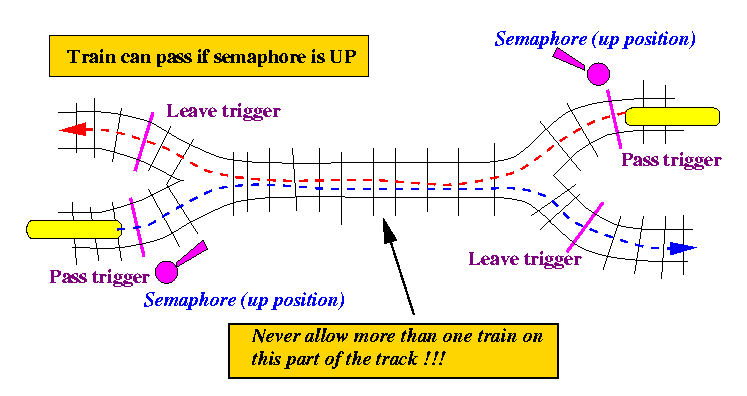
- When a train passes a semaphore,
it disables the power
of train on the other end
So there can only be one train traveling on the stretch of rail !!!
(Older semaphores will only cause the signal at the other end to set to the danger state and the conductor must manually stop the train....)
- Conceptually a
(counting) semaphore consists of:
- a (integer) count variable, and
- a queue (of threads)
- When the semaphore is defined, the
count variable is
set to a given value
and the queue is empty
Example:
semaphore s(10); // s.count is set to 10
- There are 2 operations defined on a
semaphore s:
- P(s): (pass -
Dutch: passeer)
- The operation is trying to pass
the semaphore (check point)
- If the semaphore's value is
greater than zero, then:
- P(s) is
successful (i.e., the thread
continues execution)
- The semaphore's value is decremented by one
- P(s) is
successful (i.e., the thread
continues execution)
- If the semaphore's value is
ZERO, then:
- P(s) is
unsuccesfull (i.e., the thread
will BLOCK - put in the semaphore queue)
- (The semaphore's value remains ZERO)
- P(s) is
unsuccesfull (i.e., the thread
will BLOCK - put in the semaphore queue)
- The operation is trying to pass
the semaphore (check point)
- V(s): (leave -
Dutch: verlaten)
- This operation is make the train
leave the guarded section
This operation will always be successful
- Effect:
- If the semaphore's value
is greater than zero, then:
increment count by one
- If the semaphore's value
is ZERO, and
no thread is BLOCKED in the queue,
then: set semaphore value to
ONE
- If the semaphore's value is ZERO, and some thread(s) is BLOCKED in the queue, then: UNBLOCK one of the threads
- If the semaphore's value
is greater than zero, then:
increment count by one
- This operation is make the train
leave the guarded section
Furthermore: the P(s) and V(s) operations are atomic
That means all the effects of each operations are completed without any interruption (no intervening action of any kind).
- P(s): (pass -
Dutch: passeer)
- Similar to locks,
a semaphore can be used
to access shared variables
Example code used to access a shared variable:
    int x;            // shared variable

    semaphore s(1);   // shared semaphore variable

    thread i:

        .....
	P(s);
	x = x + 1;
	V(s);
Because the semaphore is initialed to one, the number of times that P(s) will succeed is one time only.
Therefore, only one thread can pass P(s) at any time...
Mutual exclusion is ensured !
- Example
   Shared variables:

      int MAX;
      int nItems = 0;     // Number of items in buffer
      int buf[MAX];

      semaphore sender(MAX);   // Initially, let sender in MAX times
      semaphore receiver(0);   // Inirially, block receiver's entry


   Writer:

       while ( true )
       {
           int x;

           x = produce_next_value();

	   P(sender);
	   buf[writePtr] = x;             // Put x in buffer
	   writePtr = (writePtr+1) % N;
	   V(receiver);
       }


   Reader:

       while ( true )
       {
           int x;

	   P(receiver);
	   x = buf[readPtr];           // Get x from buffer
	   readPtr = (readPtr+1) % N;
	   V(sender);

	   consume_value(x);
       }
It's tricky:
- The sender can succeed
at most MAX times; then it will
block
So if P(sender) succeeds, the sender can surely find an empty slot to write into
- The receiver can
only succeed if
the sender lets it succeed
The sender "gives" credits to the receiver by using: V(receiver)
- In turn, the receiver - after taking an item from the buffer - "gives" credits to the sender by using: V(sender)
- The sender can succeed
at most MAX times; then it will
block