- A 2x2 Banyan switch has two inputs
- numbered 0 and 1
and two outputs
- numbered 0 and 1
- Banyan switch:
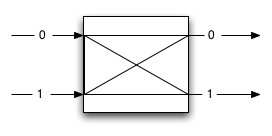
- The Banyan switch
has a switching control built
into the switch itself:
- Every packet (messages) that comes into the
Banyan switch has a header that contains
a bit indicating what its destination
is (either 0 or 1).
The header is usually the first bit of the packet (message)
- If the switch reads the bit and it has value 0,
it sends the packet to its upper output
(which is marked with 0 in the figure)
- If the switch reads the bit and it has value 1, it sends the packet to its lower output (which is marked with 1 in the figure)
- Every packet (messages) that comes into the
Banyan switch has a header that contains
a bit indicating what its destination
is (either 0 or 1).
- By connecting these simple Banyan switching elements in series and parallel, it is possible to route packets in more complicated ways depending on the desired routes to establish.
