- Main
disadvantage of
Extensible Hashing:
- The size of the
bucket array
will double each time
the parameter i incraeses by 1
- This exponential growth rate is too fast
- The size of the
bucket array
will double each time
the parameter i incraeses by 1
- Properties of the
Linear Hashing technique:
- The growth rate of
the bucket array will be
linear
(hence its name)
- The decision to
increase the
size of the
bucket array is
flexible....
A commonly used criteria is:
- If (
the average occupancy per bucket
>
some threshold
) then:
- split one bucket into two
- If (
the average occupancy per bucket
>
some threshold
) then:
- Linear hashing uses overflow buckets .....
- The growth rate of
the bucket array will be
linear
(hence its name)
- Parameters used in
Linear Hashing:
- n =
the
number of
buckets
that is
currently in use
- There is also a
derived parameter
i:
i = ⌈ log2( n ) ⌉The parameter i is the number of bits needed to represent a bucket index in binary:
    #buckets    bucket indexes
       n           used              i = ⌈log(n)⌉
    ------------------------------------------------
       1                0             1 bit     // 1 bucket  --> bucket 0
       2           0    1	      1 bit     // 2 buckets --> bucket 0 and 1
       3	  00 01 10	      2 bits
       4	  00 01 10 11	      2 bits
       5	 000 001 .. 100	      3 bits
       6	 000 001 .. 101	      3 bits
       7	 000 001 .. 110	      3 bits
       8	 000 001 .. 111	      3 bits
       9	0000 0001 .. 1000     4 bits
       ....
Note:
- The n buckets are
number as:
0, 1, 2, .... , (n−1) // In binary
- The n buckets are
number as:
- n =
the
number of
buckets
that is
currently in use
- Important property:
- When the
number (n − 1)
is written as
i bits binary number:
- The first bit in the binary number is always "1"
Example:
    n   n-1  in binary       i = ⌈log(n)⌉
  -----------------------------------------
    2    1      1            1 bits
    3    2     10	     2 bits
    4	 3     11	     2 bits
    5	 4    100	     3 bits
    6	 5    101	     3 bits
    7	 6    110	     3 bits
    8	 7    111	     3 bits
    ...       ^
              |
            first bit = 1 !!
Consequently:
- For any number
x: (n − 1) < x
< 2i-1 :
When x is written as i bits binary number:
- The first bit in the binary number (for x) is always "1"
- When the
number (n − 1)
is written as
i bits binary number:
- Example:
    n = 2   (2 buckets in use, bucket indexes: 0 .. 1)

    i = 1   (1 bit needed to represent a bucket index)
Suppose the number of records r = 3 :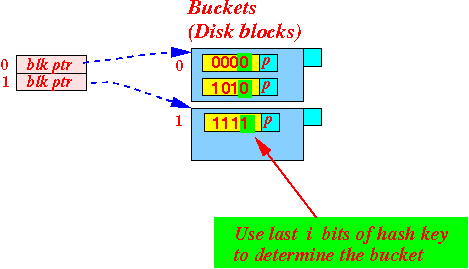
- Hash function used in
Linear Hashing:

The bucket index consists of the last i bits in the hash function value.
- A bucket in
Linear Hashing is
a chain of
disk blocks:

-
Note
- There are only n buckets
in use
- However:
- A hash key value
consists of
i bits
I.e.: A hash key value can address: 2i buckets !!!
And:
n ≤ 2i
- A hash key value
consists of
i bits
- Therefore:
- A hash key value
that is > (n − 1)
will lead to
(what I call)
ghost buckets:
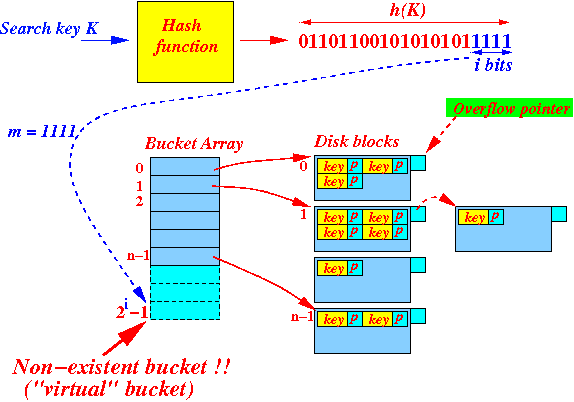
"Ghost" bucket = a non-existing bucket !!!
Conclusion:
- We will need to
map the
"ghost" (non-existing) buckets to
an existing bucket
(See below)
- A hash key value
that is > (n − 1)
will lead to
(what I call)
ghost buckets:
- There are only n buckets
in use
- Recall that:
- The first bit
of the parameter
n - 1
(= the number of bucket
that is currently in use)
written in
binary
must be equal to 1:
n - 1 = 1xxxxx...
- The first bit
of the parameter
n - 1
(= the number of bucket
that is currently in use)
written in
binary
must be equal to 1:
- Therefore:
- The "ghost" buckets
(the non-existent buckets)
must
have as
first bit
the binary number
1:
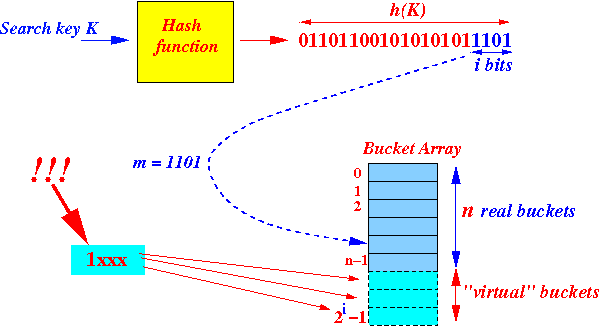
Notice that:
- When we change the
first bit of a
"ghost" bucket index from
1 to
0:
- The result index identifies
a real bucket !!!
(Because the last bucket is (n−1) starts with a 1 bit !!!)
- The result index identifies
a real bucket !!!
- The "ghost" buckets
(the non-existent buckets)
must
have as
first bit
the binary number
1:
- Commonly used criteria to
adjust (increase)
the number of buckets n
in Linear Hashing:
  if ( Avg occupancy of a bucket > τ )
  {
     n++;
  }
- How to determine
average occupancy of
a bucket:
- We need the following
parameters:
   n = current number of buckets in use
   r = current number of search keys stored in the buckets
   γ = block size (# search keys that can be stored in 1 block)
- Computation:
   Max # search keys in 1 block  = γ
   Max # search keys in n blocks = n × γ

   We have a total of:  r search keys  in n blocks

                      r
   Avg occupancy = --------
                    n × γ
Example:

- We need the following
parameters:
- Increase criteria in
Linear hashing:
            r
    if ( -------- > τ )
           n × γ
    {
       n++;
    }
- Insert Algorithm:
   Parameter: n = current number of buckets in use
              i = ⌈ log(n) ⌉

   Insert( x , recordPtr(x) )
   {
      k = h(x);               // General hash function value

      m = last i bits of k;   // Linear hash function value

      /* -----------------------------------------------
         Insert (x, recordPtr(x)) in "bucket m"
	 ----------------------------------------------- */
      if ( m ≤ n−1 )
      {
         /* =========================================
	    m is a "real" bucket
	    ========================================= */
         Insert (x, recordPtr(x)) into bucket m
            if neccessary, use an overflow block;
      }
      else
      {
         /* =========================================
	    m is a "ghost" bucket
	    Recall: first bit of m is 1
	    I.e.: m = 1xxxxxxxxx
	    ========================================= */
         m' = m with the first bit is changed to 0
	      // I.e.: m  = 1xxxxxxxxxx
	      //       m' = 0xxxxxxxxxx
	      // Note: m' is for sure a "real" bucket !!!

         Insert (x, recordPtr(x)) into bucket m'
            if neccessary, use an overflow block;
      }


      /* =============================================
         Check if we need to adjust n
	 ============================================= */
      if ( r/(n*γ) > τ )
      {
         Add bucket n;

         Let n = b1b2...;  // n = the index of the NEW bucket
	                   // n can be a binary number of i bits OR
			   // a binary number 100...000 of i+1 bits
			   // In any case, the first bit of n (b1) = 1 !!!

	 j = ⌈ log(n) ⌉ ;   // Number of binary digits for n

	 /* --------------------------------------
	    We need to move some search keys
	    into this new bucket
	    -------------------------------------- */
	 n' = 0b2... ;  // n' was the "real" bucket used to
                        // store search keys that were previously hashed
		        // into the "ghost" bucket "1b2..."

         /* ----------------------------------------------------
	    Now that this "ghost" bucket is NOW "real", we move
	    the "ghost"'s search keys into the "real" bucket
	    ---------------------------------------------------- */
	 for ( every search key k ∈ bucket n' ) do
	 {
	    if (  last j bits of k == b1b2... (i.e., = n) )
	    {
	       move search key k into the new bucket n;
	    }
	 }
      }
   }
   Parameter: n = current number of buckets in use
              i = ⌈ log(n) ⌉

   Lookup( x )
   {
      k = h(x);               // General hash function value

      m = last i bits of k;   // Linear hash function value

      if ( m ≤ n−1 )
      {
         /* =========================================
	    m is a "real" bucket
	    ========================================= */
         Search  (x, recordPtr(x)) in bucket m
            (including the overflow block);
      }
      else
      {
         /* =========================================
	    m is a "ghost" bucket
	    Recall: first bit of m is 1
	    m = 1xxxxxxxxx
	    ========================================= */
         m' = m where the first bit is changed to 0
	      // I.e.: m  = 1xxxxxxxxxx
	      //       m' = 0xxxxxxxxxx
	      // Note: m' is a "real" bucket !!!

         Search  (x, recordPtr(x)) in bucket m'
            (including the overflow block);
      }
   }
|
- Parameters:
   Max # search keys in 1 block (γ) = 2
   Threshold avg occupance (τ)        = 0.85
- Initial State:

Average occupancy:
     r         3
  ------- = ------- = 0.75
   n × γ     2 × 2
- Insert search key
K such that
h(K) = 0101
- Insert
0101:

Result:

Average occupancy:
     r         4
  ------- = ------- = 1 > τ (0.85)
   n × γ     2 × 2
- Insert
0101:
- We must add
an new bucket:
- Add bucket
2 (= 10 (binary)):

- Transfer search keys from
bucket 00 to
the newly created bucket
10:

Result:

Average occupancy:
     r         4
  ------- = ------- = 0.6666 ≤ τ (0.85)
   n × γ     3 × 2
Notice that:
- n = 3 (changed) !!!
- i = 2
(changed) !!!
- We can find 1111 as follows:

Explanation:
- 1111
will lead to
the bucket
11
(using the last i (= 2) bits)
which is a
"ghost" bucket
- The search algorithm will use the real bucket 01 instead !!!
- 1111
will lead to
the bucket
11
(using the last i (= 2) bits)
which is a
"ghost" bucket
Continue example....
- Add bucket
2 (= 10 (binary)):
- Insert search key
K such that
h(K) = 0001
- Insert
0001:

Result:

So: Linear Hashing uses overflow blocks !!!
Average occupancy:
     r         5
  ------- = ------- = 0.833333 ≤ τ (0.85)
   n × γ     3 × 2
No need too add another bucket.....
Continue example....
- Insert
0001:
- Insert search key
K such that
h(K) = 0111
- Insert
0111:

Result:

Average occupancy:
     r         6
  ------- = ------- = 1 > τ (0.85)
   n × γ     3 × 2
- Insert
0111:
- We must add
an new bucket:
- Add bucket
3 (= 11 (binary)):

- Transfer search keys from
bucket 01 to
the newly created bucket
11:

Result:

Average occupancy:
     r         6
  ------- = ------- = 0.75 ≤ τ (0.85)
   n × γ     4 × 2
Notice that:
- n = 4
(changed) !!!
- Every search key
in the Linear Hash table is
now
identified by their
last 2 bits:
- Add bucket
3 (= 11 (binary)):
- Delete was not discussed in
the text book
- But if you understand
how it works,
you can easily devise
an algorithm to
reduce the
number of buckets
Hint:
- When a bucket is delete,
it becomes a
"ghost" bucket
- If the bucket contains
some search keys,
you will need to
move these
search keys....
Where do you move them ???
- When a bucket is delete,
it becomes a
"ghost" bucket