- Example Query Tree:
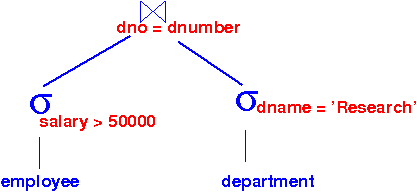
- Fact:
- A query consists of a hierarchy (= tree) of physical (query plan) operators
- Data flow:
- The result of the operators at the lower level in the tree must be passed (up) to some operator at a higher level in the tree
- There are 2 techniques
used to
pass the
result of
one operator to
another operator:
- Materialization:
- The output of the
operator is
written
(as a temporal relation) to
disk
- The receiving operator will read the tuples from disk
Graphically:

- The output of the
operator is
written
(as a temporal relation) to
disk
- Pipelining:
- The output of the
operator is
stored
in one or more
memory buffer(s)
- The receiving operator will read the tuples from the memory buffer
Graphically:

- The output of the
operator is
stored
in one or more
memory buffer(s)
- Materialization:
- Advantage/disadvantages:
- Materialization:
- Simple to
implement
- High I/O costs....
- Low memory size
requirement
(because we do not use
extra memory buffers)
- Very attractive for small memory computer systems
- Simple to
implement
- Pipelining:
- Harder to
implement
- The commonly used technique
to implementing pipelining is:
- Iterator objects
- The commonly used technique
to implementing pipelining is:
- Lower I/O costs....
- High memory size
requirement
(because we need extra memory buffers)
- Attractive for large memory computer systems
- Harder to
implement
- Materialization:
- Iterator:
- Iterator =
an (program) object that provides
(at least) the following
3 methods (operations):
- open():
- This method
starts (prepares)
the process of
getting tuples
The method does not return any tuple
- The open() method will
initialize some
data structures (e.g., buffers)
needed to
get tuples
- If the
object is
a stored relation
(on disk),
the open() method will
open the
file of the relation
Otherwise (the iterator uses the result of other operators), the open() method will call the open() method of its argument(s)
- This method
starts (prepares)
the process of
getting tuples
- getNext():
- The getNext() method
returns the
next tuple
in the
object if
there are tuples remaining.
The getNext() method returns NOT-FOUND if the object has no more tuples.
- The getNext() method must update its data structure to allow subsequent tuple(s) to be retrieved
- The getNext() method
returns the
next tuple
in the
object if
there are tuples remaining.
- close():
- The close() method
cleans up the
object
De-allocate any memory used for data structures created by open()
- If the object is
a stored file,
the close() method will
close the opened file
Otherwise (the iterator uses the result of other operators), the close() method will call the close() method of its argument(s)
- The close() method
cleans up the
object
- open():
- Iterator =
an (program) object that provides
(at least) the following
3 methods (operations):
- The following pseudo code
are the
implementation
of the
Table-Scan
iterator
at the kernel level
I.e.:
- You perform the buffering of the disk blocks by yourself
- Open():
    Open( )
    {
       Open target relation R;

       Allocate 1 block buffer space at b;

       b = read first block of R;
       t = points to first tuple in block b;
    }
- getNext():
   getNext( )
   {
      /* ==============================================================
         Make sure t points to a valide tuple before proceeding
	 ============================================================== */
      if ( tuple t has passed the last tuple in block b )
      {
         /* -------------------------------------------------
	    Re-position t to be the first tuple of next block
	    ------------------------------------------------- */
         Read the next block into b;

	 if ( there is no next block )
	 {
	    return NotFound;
	 }
	 else
	 {
	    t = first tuple in block b;
	 }
      }

      /* ===========================================
         Here: t points to a valid next tuple
	 =========================================== */

      curr_t = t;          // Save the return value

      increment t to the next tuple in block b;

      return curr_t;
   }
- Close( ):
   Close( )
   {
      free buffer;

      close file;
   }
- Bag union:
- Bag union = a union operation that does not remove duplicates
The implementation of BagUnion will illustrate the pipelining effect :
- The tuples used by
BagUnion are
obtained by
calling the
getNext( ) method
in ScanTable
- The effect is:
- The tuples are passed from one operation to another operation through main memory (buffer)
- Open( ):
   ScanTable R, S = input relations to BagUnion

   Open( )
   {
      R.Open();         // Call the Open() method in ScanTable !!!

      CurrRel = R;
   }
- getNext():
   getNext()
   {
      if ( currRel == R )
      {
         t = R.getNext();       // Call ScanTable to get next tuple

	 if ( t ≠ NotFound )
	 {
	    /* ------------------------------
	       We read a valid tuple from R
	       ------------------------------ */
            return t;
         }
	 else
	 {
	    /* ===========================
	       R is done, we read S next
	       =========================== */

	    S.Open();       // Call ScanTable's Open()

	    currRel = S;    // Make this if-statement stop executing
         }
      }

      /* =============================================
         We will only reach here if R is exhausted...
	 ============================================= */
      return S.getNext();
   }
- Close( ):
   Close( )
   {
      R.Close( );
      S.Close( );
   }
- We can see the effect of
a pipeline of
iterators in the
previous example:
- BagUnion uses the following
2 input arguments to
compute the union:
    R
    S
- The tuples of the relations
are fetched by
an iterator ScanTable
- The iterator ScanTable passes the tuples of a relation to BagUnion through a memory buffer
- BagUnion uses the following
2 input arguments to
compute the union:
- Iterators
can eliminate
the need to
materialize
a relation
as follows:
- A pipeline of
iterators is
created:

the result of one operator is passed to the input of the next operator through memory (buffer) without having to write the tuples to disk
- A pipeline of
iterators is
created:
- Sort-scan:
- Return the tuples in a relation in a sorted order
The implementation of Sort-scan will illustrate that iterator is not always the most suitable approach to implement the operator
- Open():
    Open( )
    {
       Open target relation R;

       Read all tuples of R into memory;
       Sort the tuples;

       b = points to first block of R;
       t = points to first tuple in block b;
    }
- getNext():
   getNext( )
   {
      /* ==============================================================
         Make sure t points to a valide tuple before proceeding
	 ============================================================== */
      if ( tuple t has passed the last tuple in block b )
      {
         /* -------------------------------------------------
	    Re-position t to be the first tuple of next block
	    ------------------------------------------------- */
         Make b point to the next block of R;

	 if ( there is no next block )
	 {
	    return NotFound;
	 }
	 else
	 {
	    t = first tuple in block b;
	 }
      }

      /* ===========================================
         Here: t points to a valid next tuple
	 =========================================== */

      curr_t = t;          // Save the return value

      increment t to the next tuple in block b;

      return curr_t;
   }
- Close( ):
   Close( )
   {
      free buffers;

      close file;
   }
- Note:
- The implementation requires
a large amount of
memory buffer and
it clearly
undesirable.
- Materialization in
this case, will be a
better approach
(A Scan-Table iterator can then be used to access the sorted result on disk.
The pipeline will become "segmented")
- The implementation requires
a large amount of
memory buffer and
it clearly
undesirable.
- ScanTable:
- Read tuples from
a relation stored on disk
- When you use UNIX system calls,
you rely on
the UNIX O.S. to perform the
buffering for you....
Things will be a little different
- Read tuples from
a relation stored on disk
- The header file:
   class ScanTable
   {
   public:
      FILE *fp;
      int  fd;
      char TableName[33];          // Name of the relation

      DataDescription DataDes[10];  /* Holds data descriptions
   					      for upto 10 fields */
      int  n_fields;                       /* Actual # fields */
      int  record_size;

      char buf[1000];                      // Buffer to store tuples

      int Open(char *relname);
      int GetNext();
      void Close();

      int getAttrType( char *attrName );   // Get data type of attr attrName
      int getAttrSize( char *attrName );   // Get size of attr attrName
      void *getAttrPtr( char *attrName );  // Get pointer to attrName in buf[1000]

      void PrintTuple();
      void PrintRelationInfo();
   };
- The implementation of
the Open() method:
   int ScanTable::Open(char *relname)
   {
      /* ------------------------------------------------
         Open the catalog to file the relation definition
	 ------------------------------------------------ */
      if ( (fp = fopen("catalog", "r")) == NULL )
      {
   	 cout << "Error: cannot open database catalog `./catalog'" << endl;
   	 return 0;
      }

      n_fields = 0;
      record_size = 0;

      /* ==================================================
   	    Read attribute information on relation "relname"
   	 ================================================== */
      while ( fscanf(fp, "%s %s %c %d %d",
   		DataDes[n_fields].relname, DataDes[n_fields].fieldname,
   		&DataDes[n_fields].fieldtype, &DataDes[n_fields].startpos,
   		&DataDes[n_fields].fieldsize) > 0 )
      {
   	 if ( strcmp( DataDes[n_fields].relname, relname ) == 0 )
   	 {
	    /* =========================================
	       This field belongs to the relation !
	       Adjust the computation of the record size
	       ========================================= */
   	    if ( DataDes[n_fields].startpos
                 + DataDes[n_fields].fieldsize > record_size )
   	    {
   	       record_size = DataDes[n_fields].startpos
   			    + DataDes[n_fields].fieldsize;
   	    }

   	    n_fields++;    // Accept this field
   	 }
      }

      fclose(fp);            // Close the catalog

      /* -----------------------------------------
         Check if the relation "relname" was found
	 ----------------------------------------- */
      if ( n_fields > 0 )
      {
         /* =======================================
	    Found: open the data file
	    ======================================= */
   	 if ( (fd = open(relname, O_RDONLY)) == -1 )
   	 {
   	    cout << "Error: canot open relation file " << relname << endl;
   	    return 0;
   	 }

   	 strcpy( TableName, relname);

   	 return 1;                     // Return success code
      }
      else
      {
   	 return 0;                     // Return error code
      }
   }
Note:
- I was lazy to allocate
a buffer dynamically.
- Better code is:
     char *buf;

     buf = malloc( record_size + 1 );
- I was lazy to allocate
a buffer dynamically.
- The implementation of the
getNext() method:
   int ScanTable::GetNext()
   {
      int n;

      n = read(fd, buf, record_size+1);

      /* ----------------------------------------
         Return a success or error code
	 ---------------------------------------- */
      if ( n == record_size+1 )
      {
   	 return 1;
      }
      else
      {
   	 return 0;
      }
   }
- The implementation of
the Close() method:
   void ScanTable::Close()
   {
      close(fd);           // Close relation file
   }
- Here is a simple program on
how to use an
iterator:
  ScanTable *f = new ScanTable();

  if ( f->Open( "relationName" ) == 0 )
   {
      cout << "Relation not found !" << endl;
      exit(1);
   }

   while ( f->GetNext() != 0 )
   {
      /* ------------------
         Print it...
         ------------------ */
      f->PrintTuple();      // I added a print tuple method in the class....
   }

   f->Close();
- Example Program:
(Demo above code)

- Prog files: see /home/cs554000/Handouts/Data
How to run the program:
- To compile: make
- To run: print-data test