- Protocol summary:
- Sense channel before
transmitting a packet
- If channel is clear:
- Transmit packet
- Wait for
ACK
- If ACK is not received within a time out period, assume collision (i.e.: back off)
- Transmit packet
- If channel is busy:
- Back off
- Back off protocol:
- Select a
random number
(range of the
randon numbers
is increasing exponentially)
- Decrement count down counter when the channel is idle
- Select a
random number
(range of the
randon numbers
is increasing exponentially)
- Sense channel before
transmitting a packet
- The analysis procedure consists of
2 parts:
- Find τ = the
steady state probability
that a station
transmits a packet in a
arbitrary slot time
- FInd the fraction of slots that are successful
- Find τ = the
steady state probability
that a station
transmits a packet in a
arbitrary slot time
- State transition diagram:
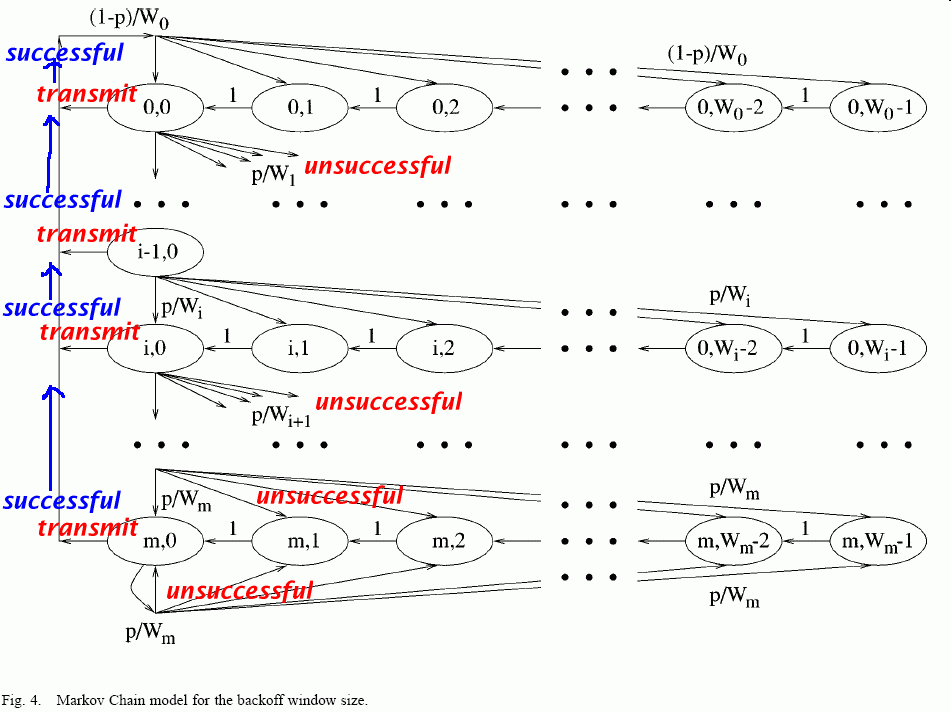
- The probability τ
that a station
transmits a packet is equal to:
-
τ =
b0,0 + b1,0 + ... + bm,0
(bi,j = the steady state probability that the system is in state (i,j))
-
τ =
b0,0 + b1,0 + ... + bm,0
- The equilibrium (steady state)
equations obtained from the
(Markov) state transition diagram:
     b1,0 = p × b0,0                     .... (E1a)

     b2,0 = p2 × b0,0                    .... (E1b)

     b3,0 = p3 × b0,0                    .... (E1c)

     ...

     bm-1,0 = pm-1 × b0,0                 .... (E1x)

             pm
     bm,0 = ----- × b0,0                 ....... (E3)
            1-p


            (Wi - k)
     bi,k = --------- × p × bi-1,0     (for i = 1, 2, ..., m-1  and  k > 0)    ........ (E4)
               Wi

            (Wm - k)
     bm,k = --------- × p × (bm-1,0 + bm,0)        (for k > 0)                 ...... (E5)
               Wm


            W0 - k
     b0,k = -------- × (1-p) × (b0,0 + b1,0 + .... + bm,0)                     ...... (E6)
              W0
- The solution for
bi,j
in terms of b0,0
     b1,0 = p × b0,0                     .... (E1a)

     b2,0 = p2 × b0,0                    .... (E1b)

     b3,0 = p3 × b0,0                    .... (E1c)

     ...

     bm-1,0 = pm-1 × b0,0                 .... (E1x)

             pm
     bm,0 = ----- × b0,0                 ....... (E3)
            1-p


            (Wi - k)
     bi,k = --------- × pi × b0,0     (for i = 1, 2, ..., m-1  and  k > 0)    ........ (E7)
               Wi

            (Wi - k)
     bm,k = --------- × pm × 1/(1-p) × b0,0                                    ...... (E8)
               Wi


            W0 - k
     b0,k = -------- × b0,0                                             ....... (E9)
              W0
with b0,0 equal to:
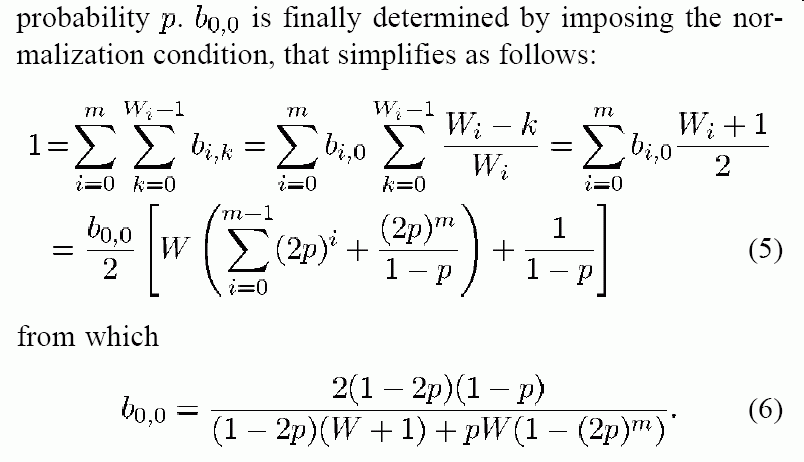
- τ is equal to:
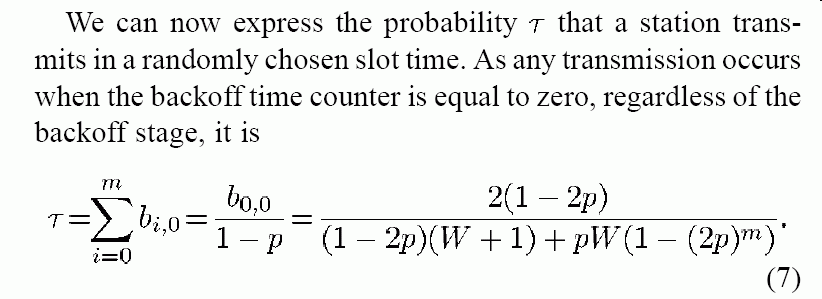
- Probability that a transmission is successful:
- Ҏ[ successul transmission] = (1 − τ)n−1
- p = Probability that a transmission is unsuccessful:
- p = Ҏ[ unsuccessul transmission] = 1 − (1 − τ)n−1
- τ and
p can be found by
solving this
non-linear system:
                   2(1-2p)
     τ = ----------------------------              ...... (7)
         (1-2p)(W+1) + pW(1 - (2p)m)

     p = 1 - (1-τ)n-1                               ...... (9)
- In general, a transmission channel
goes through the following cycles:

- Therefore,
the normalized throughput
can always be
expressed as follows:
        Total amount of useful time
   S = --------------------------------
           Total amount of time

 Or:

         Avg. length of the payload in a slot × Ҏ[ slot contains exactly one transmission  ]
   S = ----------------------------------------------------------------------------------------
                                   Avg. length of a slot

           E[P] × Ptr × Ps
      = -------------------------
          Avg. length of a slot

 where:
        Ptr = probability that a slot contains a transmission
	Ps = probability that transmission is successful
        E[P] = Avg. length of the payload in a slot
With:
      Ptr = Ҏ[ at least 1 terminal transmit ]

          = 1 - (1 - τ)n
and:
Ps = Ҏ[ a transmission is successful ] n τ (1 - τ)n-1 = ----------------- 1 - (1 - τ)n(E[P] was assumed to be constant (because I did not want to deal with variable packet length)
- Avg. length of a slot:
   Avg. length of a slot = Weighted average of the length of the 3 diff. kinds of slot

                         =  Ҏ[ 0 transmission ] × σ
			    + Ҏ[ 1 transmission ] × Ts
			    + Ҏ[ > 1 transmission ] × Tc

                         = (1 - Ptr)×σ + (PtrPs)×Ts + (Ptr(1-Ps))×Tc
where:
- Ts =
Avg. length of a slot when
the slot contains a
successful transmission
- Tc =
Avg. length of a slot when
the slot contains a
unsuccessful transmission
(collision)
- σ =
"empty slot time",
time
needed for a station to detect
the transmission
(of a packet) from
any other station
(This value is like the end-to-end propagation delay on an Ethernet network)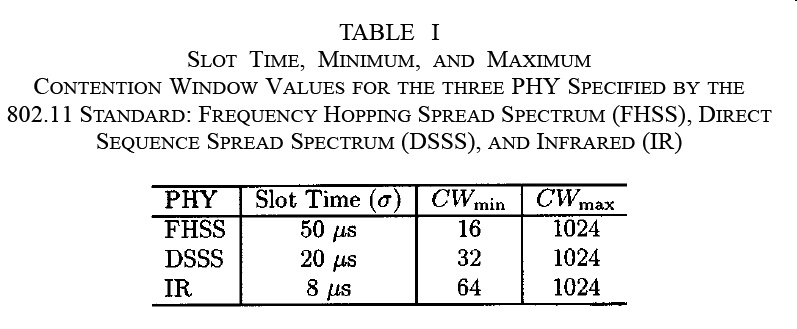
- Ts =
Avg. length of a slot when
the slot contains a
successful transmission
- The following figure shows a
successful and
an unsuccessful transmission
using the
basic access method:
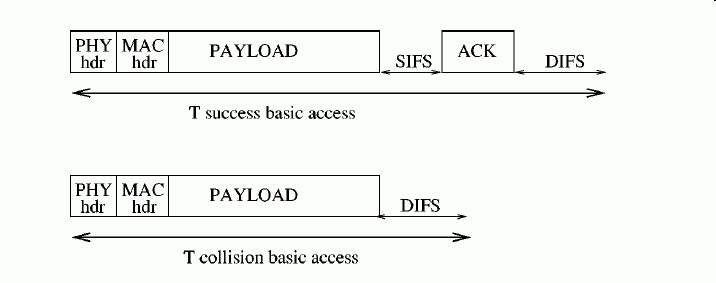
- Therefore:
    Ts = ( H + E[P] + SIFT + δ ) + ( ACK + DIFS + δ )      ..... (6)

    Tc = H + E[P] + DIFT + δ                               ..... (7)
- The following figure shows a
successful and
an unsuccessful transmission
using the
RTS/CTS access method:
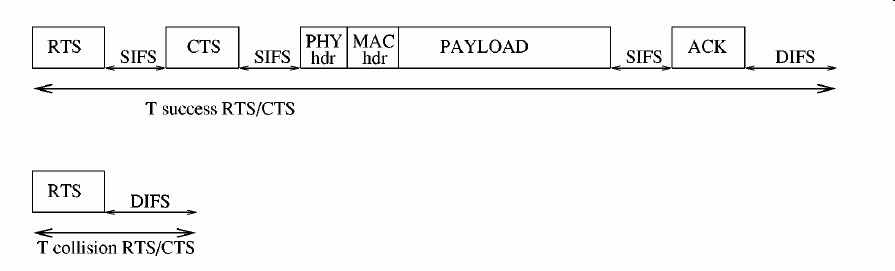
- Therefore:
    Ts = ( RTS + SIFT + δ ) + ( CTS + SIFT + δ )
         + ( H + E[P] + SIFT + δ ) + ( ACK + DIFS + δ )      ..... (8)

    Tc = RTS + DIFT + δ                                      ..... (9)