- The Random Early Detection
(active) queue method can solve the
Synchronized Packet Drop
problem (that cause global TCP synchronization)
- Achieves a form of fairness: Packets from each flow have the same drop probability (but this is NOT the form of fairness: that we would want to achieve !!!)
- The authors of the paper
"Dynamics of Early Random Drop"
discovered the following short-comings in
RED:
- RED
has a
bias against
low band width flows
- RED
can exhibit unfair behavior among
identical flows
- RED
cannot
reduce the transmission rate of
UDP flows
(UDP is a less commonly used Transport Protocol that are mostly used to transmit real time data, such as video and audio)
The UDP protocol is concerned about speed and it is completely unconcerned about packet losses
In particular, the UDP protocol will NOT reduce its transmission rate when packets are lost
(It's even worst, UDP does NOT detect packet loss, so it won't even KNOW if some packets are lost)
- RED
has a
bias against
low band width flows
- The data traffic on the
Internet is very
diverse
- Lin and Morris
distinguish
3 different
categories of flows in their paper
"Dynamics of Early Random Drop":
- Non-adaptive (UDP) traffic:
- UDP based network applications
will
not slow down
when some packets are lost
Examples applications that uses UDP: video and audio
- UDP based network applications
will
not slow down
when some packets are lost
- Robust TCP flow (large CWND):
- Robust TCP flows
are
TCP flows
that is using a
large CWND
The TCP connection is transfering a large amount of data (e.g., large file transfer)
An occasional packet loss will be detected and recovered through triple duplicate ACK
(because there is large number packets outstanding that can generate duplicate ACKs)
In a robust TCP flow, packet losses seldom cause timeout recovery
Consequently, robust TCP flows have large CWND values.
(Because they do not perform slow start that makes CWND = 1 !)
Example robust TCP flows: file transfer
BTW, robust TCP flows are called "elephants"
- Robust TCP flows
are
TCP flows
that is using a
large CWND
- Fragile TCP flows:
- Fragile TCP flows
are
TCP flows
with a
small CWND
The TCP connection sends data only occasionally
A packet loss will often ends in timeout recovery because there are not enough packets following the lost packet to generate 3 duplicate ACK
In fragile TCP flows, packet losses often cause timeout recovery
Consequently, fragile TCP flows will (keep) use small CWND values
Example: telnet. SSH, HTTP connections
BTW, the fragile TCP flows are called "mice"
- Fragile TCP flows
are
TCP flows
with a
small CWND
- Non-adaptive (UDP) traffic:
- Experiment that shows:
- RED favors robust flows and is biased against fragile flows
Simulation Network:
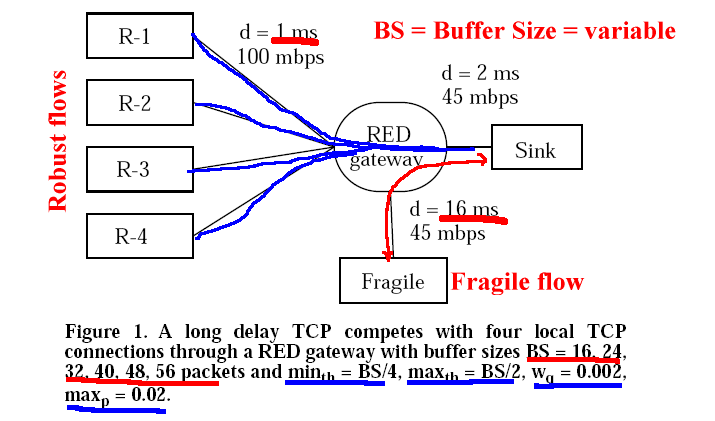
Notes:
- (Packet size used = 512 bytes)
- Competing flows:
- 4 robust flows
Simulated using very short RTT (6 msec) to increase CWND rapidly
The Advertised Window is set to very high
- 1 fragile flows
Simulated using large RTT (36 msec) to increase CWND slowly
The Advertised Window is set to 16
The maximum throughput of the fragile flow is then:
- Max throughput = 8 packets in 36 msec = (8 * 0.5 Kbytes) / 36 msec ~= 0.11 Mbps
- 4 robust flows
- Ideal bandwidth sharing
- The bandwidth of the
bottle neck link is =
45 Mbps
- 45 Mbps
is shared equally among 5 flows:
- Each flow should get: 9 Mbps
- The maximum throughput
of the fragile flow is
0.11 Mbps -
well below the fair share.
- If RED
is
fair ,
then:
- the fragile flow should get 0.11 Mbps ....
- The bandwidth of the
bottle neck link is =
45 Mbps
Simulation result:

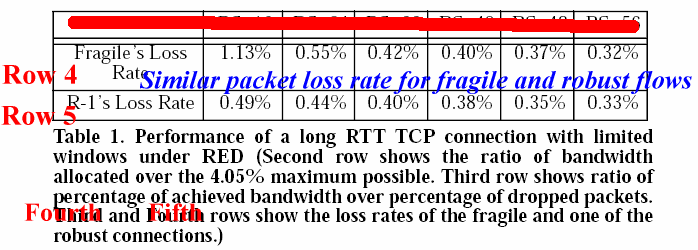
Notes:
- When Buffer space = 16 packets, the fragile flow obtains 45% of the rightful 0.11 Mbps bandwidth
- At best,
(when Buffer space = 56 packets),
the fragile flow
obtains
71% of the rightful
0.11 Mbps bandwidth
- Conclussion: RED is unfair to fragile flows
-
RED
can exhibit
unfair behavior
among
identical flows
Simulation Network: (2 identical flows)
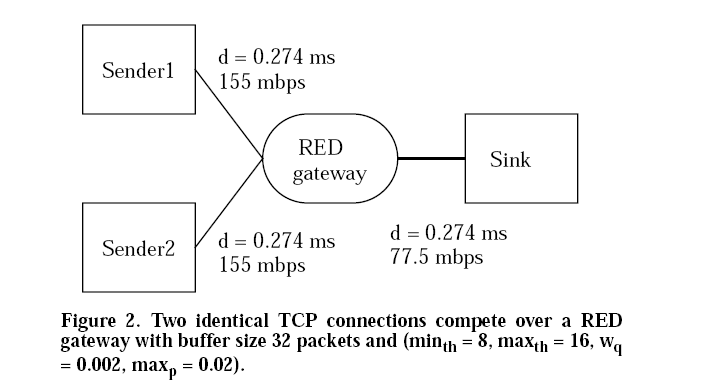
The simulation is ran many times
The CWND values of the two identical flows in some of the experiements:
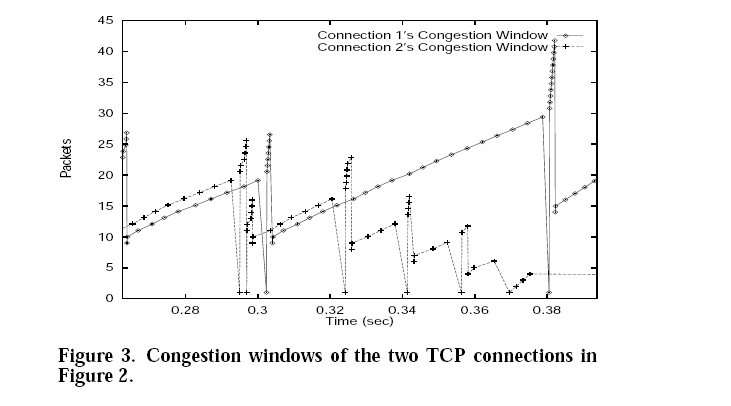
Notes:
- CWND values
diverges
after
t = 0.32 sec
- Reason:
- RED
drops packets
arbitrarily
- Therefore,
occasionally
muiltiple packets
of the
same flow
are dropped
- That flow
will perform a slow start
while the other flow
increases its CWND
- One of the flow has become a fragile flow while the other flow remains a robust flow....
- RED
drops packets
arbitrarily
The throughput plot of the two identical flows in some of the experiements:
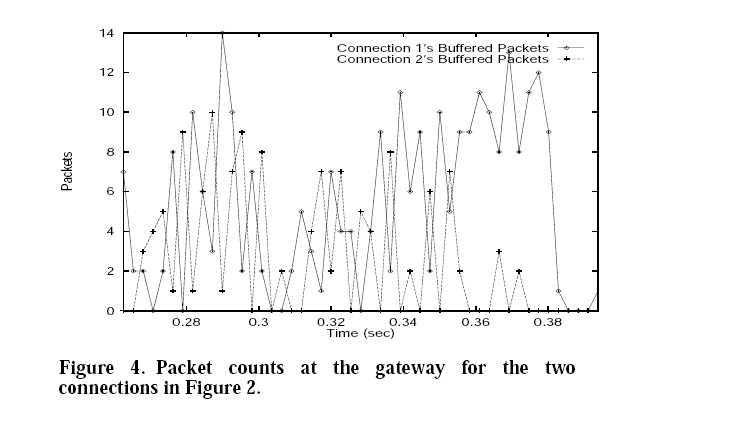
Note:
- Throughput alos diverges after t = 0.32 sec
- CWND values
diverges
after
t = 0.32 sec
-
RED
is
completely useless
for controlling
UDP flows
Simulation Network: (1 UDP flow with 1 TCP flow)
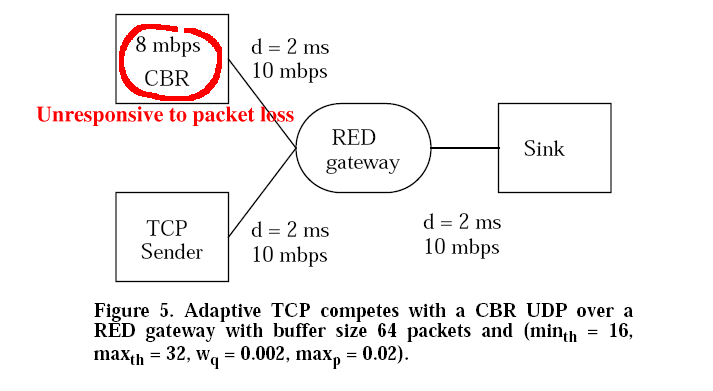
Notes:
- The UDP flow
and
the TCP flow
shares a bottle neck link of
10 Mbps
- The UDP flow
transmits data at
8 Mbps
- Fair sharing:
- Each flow should receive 5 Mbps
The Throughput plot for the UDP/TCP experiment:
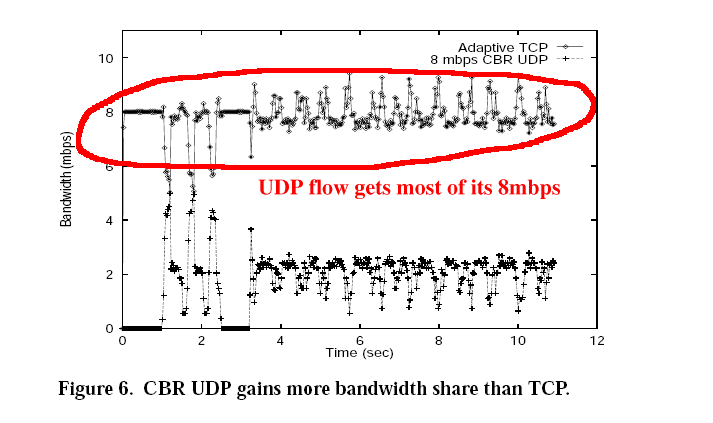
Result:
- The UDP flow's
throughput is approximately
8 Mbps
- much higher than the fair share of 5 Mbps
- The TCP flow's throughput is about 2 Mbps - much lower than the fair share of 5 Mbps
- The UDP flow
and
the TCP flow
shares a bottle neck link of
10 Mbps
- Notable requirement:
- FRED maintains state information for every flow inside a Internet router
(BTW, requiring additional information inside an Internet router will almost always guarantee that your method will only be academically relevant
Because no company will ever put the information in their routers)
- FRED uses similar parameters
as RED:
- minthreshold (queue threshold to start random drop)
- maxthreshold (queue threshold to start deterministic drop)
- maxp (max. random drop probability)
- wq (expontial averaging factor)
- FRED's operation:
- FRED counts the
number of active flows
- FRED counts the
number of packets
in each flow
(i.e., per flow accounting)
- FRED compute the
average number of packets
sent per flow
(= avgcq)
- FRED tries to make sure that:
- the number of packets in
each flow
in the router buffer
is between:
-
minq
....
maxq
FRED will penalize flows that has:
- average flow queue size > avgcq
(these flows use more than the average)
- the number of packets in
each flow
in the router buffer
is between:
- FRED
remembers
persistently misbehaving flows :
- When a packet
is dropped from
a flow f,
a strike is
recorded for flow f.
- Packets from flows with 2 or more strikes are more likely to be dropped...
- When a packet
is dropped from
a flow f,
a strike is
recorded for flow f.
- FRED counts the
number of active flows
- Various parameters and variables
 Parameters:

   wq    = 0.002 (exponential factor in averaging queue size)
   minth = min. threshold = min(buffer size/4, RTT)
   maxth = 2 * minth
   minq  = safe threshold (no drops)
	  (2 for small buffers, 4 for large buffers)


 Global variables (one such variable only):

   q     = current (INSTANTANEOUS) queue size
   avg   = AVERAGE queue size
   time  = current time
   count = number of packets since last drop

   avgcq = average queue size / # flows
   maxq  = max. # packets allowed per flow


 Per flow variables (one variable per flow):

   qlenf   = # packets of flow f in queue
   strikef = # packets dropped from f


 Mapping functions:

   conn(P)   = connection ID of packet P
   f( time ) = linear function of variable "time"
- The Flow RED algorithm for
packet arrival:
   P = arriving packet


   f = conn(P);   // connection ID of packet P
The program below processes an arriving packet of flow f
- Flow RED
packet transmission
algorithm:
   P = transmitted packet


   f = conn(P)
The program below processes an arriving packet of flow f
- When does
RED compute avg. queue length:
- RED , compute the average queue length only when a packet arrives
Problem:
- The average queue length
can be
wrong
for long period of time
Case in point:
- In a period where
there are no arrival
(and packets are
begin transmitted),
the queue length
is dropping
- Yet, the average queue length in RED does not get updated
- In a period where
there are no arrival
(and packets are
begin transmitted),
the queue length
is dropping
- Changes in FRED queue update algorithm:
- The average queue length
is computed:
- when a packet arrives and
- when a packet is transmitted
- FRED also maintain
per flow queue lengths
(I.e., FRED computes the (current) queue length for each flow)
- The average queue length
is computed:
- CalculateQueueLength(): compute average queue length
-
NOTE:
CalculateQueueLength()
is called from within
FRED algorithm
- once when a packet is received and
- once when a packet is transmitted
- see above algorithms
   CalculateQueueLength()
   {
      // -------------------------------------------
      // This is RED's avg. queue lenght algorithm
      // -------------------------------------------
      if ( q > 0 || packet was transmitted )
      {
   	 avg = ( 1 - wq ) * avg + wq * q;
   		   // avg is computed every time a packet is
   		   // transmitted (was omitted in RED)
      }
      else
      {
   	 m = f ( time - q_idle_time );

   	 avg = (1 - wq)m * avg;

   	 q_idle_time = time;
      }

      // ----------------------------------------------
      // Compute the average occupancy for each flow
      // ----------------------------------------------
      if ( NActive > 0 )
      {
   	 avgcq = avg / NActive;  // That's how many packet a flow should have in queue
      }
      else
      {
   	 avgcq = avg;  // Just a choice the author made...
      }

      // Fix "underflow problem"
      if ( avgcq < 1 )
   	 avgcq = 1;


      if ( q == 0 || packet was transmitted )
   	 q_idle_time = time;
   }
- FRED can prevent NON-ADAPTIVE from
hogging the bandwidth
4 TCP flows are started at different times: 20 sec, 40 sec, 60 sec and 80 sec.
Throughput plot:
- The simulation clearly shows that FRED can effectively drop packets from the un-responsive UDP flow without penalizing the adaptive TCP flows.
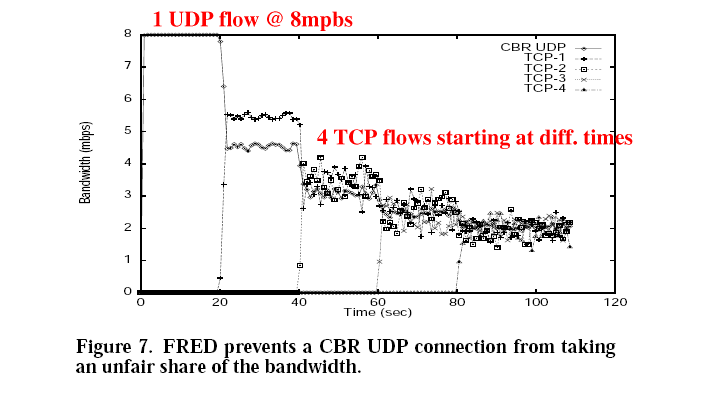
- FRED is able to distinguish
robust flow
and
fragile flow:
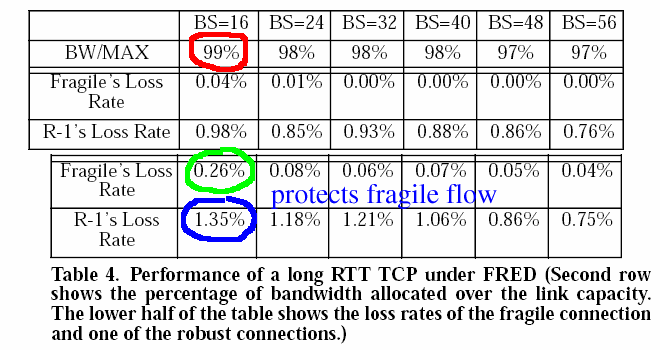
Results:
- Relatively more packets are dropped from the
robust flow(s)
than from the
fragile flow(s)
- As a result, the fragile flow(s) achieves nearly 100% of its fair share of bandwidth(s)
- Relatively more packets are dropped from the
robust flow(s)
than from the
fragile flow(s)
- The "basic" FRED algorith does not do very well when
a large number
of (TCP) flows share a bottle neck link.
- If there is a large number
of (TCP) flows, the queue in the router may be
near its capacity
- When the queue is
nearly full,
a short burst of packet arrival will cause
a queue overflow
- When a queue overflow
happens, the
FRED
algorithm degenerates into
drop tail
And we know that drop tail cannot protect anything.
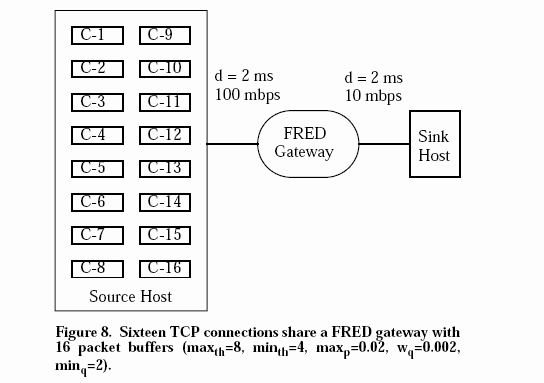
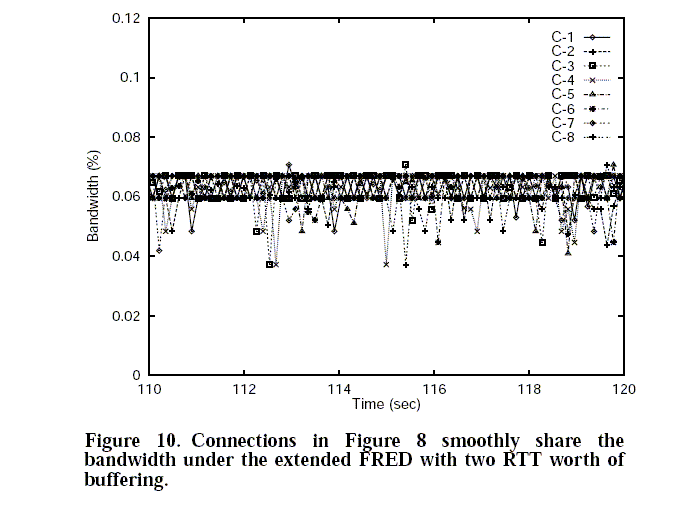
- The authors propose to allocate
2 packet buffer space
for each flow when there are "many" flows
(i.e., buffer is nearly full).
- This is a simulation scenario of many (16) TCP flows:
This is the throughput results using "basic" FRED:
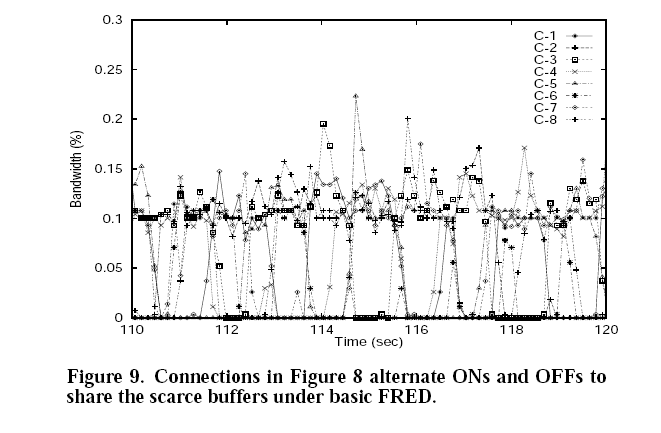
(The throughput of the last 8 TCP connections are not displayed - it's already crowded...)
This is the throughput results using "limited buffer size" FRED:
- We can conclude that - like RED - FRED also have "parameter setting problems" (hard to fix a set of parameters that will be suitable for all situations)