- Round Robin:
- Packets from different flows
are stored in different queues
- Queues are serviced in a Round-Robin manner
Graphically:
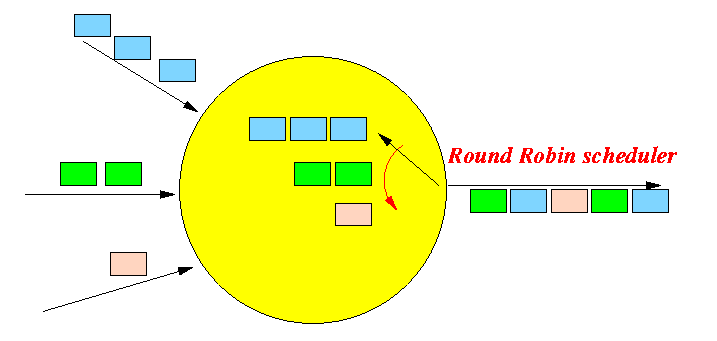
- Packets from different flows
are stored in different queues
- Fairness guarantee by Round Robin:
- If flows f and g
are backlogged over the
interval
[t1,
t2] then:
- | Wf(t1, t2) − Wg(t1, t2) | ≤ 1 packet
- Proof:
- Since flows f and g
are backlogged over the
interval
[t1,
t2],
the Round Robin scheduler will
transmit
one packet from flows f and g
in each round
- The difference
| Wf(t1, t2) −
Wg(t1, t2) |
will be zero,
except during the time when the
Round Robin scheduler:
- has already transmitted a packet from one flow and
- going to transmit a packet from the other flow
- Therefore:
- | Wf(t1, t2) − Wg(t1, t2) | ≤ 1 packet
- Since flows f and g
are backlogged over the
interval
[t1,
t2],
the Round Robin scheduler will
transmit
one packet from flows f and g
in each round
- If flows f and g
are backlogged over the
interval
[t1,
t2] then:
- Conclusion:
- The Round Robin scheduler
can achieve
fairness if
- flows have equal weights
(i.e., unweighted)
- All packets have the same size
- flows have equal weights
(i.e., unweighted)
- The Round Robin scheduler
can achieve
fairness if
- Sheerhar and Varghese presented
in
- "Efficient Fair Queueing using Deficit Round Robin" ( click here )
a very nice generalization of the round robin scheduler that can provide fairness when:
- flows have different weights
- packets can have different sizes
- Information maintained by the unweighted DRR scheduler:
- Deficit counter
= the
number of bytes
that a flow is
allowed to transmit
when it is its turn.
- Quantum
= the
number of bytes
that is added to
the deficit counter
of flow in each round
( Quantum = amount of credit per round)
- Deficit counter
= the
number of bytes
that a flow is
allowed to transmit
when it is its turn.
- Operation of the DRR scheduler:
- Packets from
flows are
transmitted in a
round robin
manner
- The quantum
is
added
to the
deficit counter
of a flow before servicing a flow.
- deficit counter(f) = deficit counter(f) + quantum
- A packet
from a flow is
only transmitted
if:
- deficit counter ≥ length of packet
- If a packet is
transmitted,
the deficit counter
of that flow is
updated as follows:
- deficit counter(f) = deficit counter(f) − (#bytes in packet)
Note:
- When the DDR router detects the first packet of a new flow, it allocates a deficit counter for the new flow and initialize the deficit counter to zero
- Packets from
flows are
transmitted in a
round robin
manner
- Example:
- 3 flows
- Quantum = 500 (bytes)
Graphically:
          Deficit
	  counters

          +-----+
  flow 1  |  0  |
          +-----+
          +-----+
  flow 2  |  0  |
          +-----+
          +-----+
  flow 3  |  0  |
          +-----+

  Quantum = 500
- Packet arrivals:
          Deficit
	  counters

          +-----+     +------------+ +---------------------------+
  flow 1  |  0  |     |  200 bytes | | 		400 bytes	 |
          +-----+     +------------+ +---------------------------+
          +-----+     +-----+ +------------+ +-------------------+
  flow 2  |  0  |     | 100 | |  200       | | 300 bytes	 |
          +-----+     +-----+ +------------+ +-------------------+
          +-----+     +------------+ +------------+ +------------+
  flow 3  |  0  |     |  200 bytes | | 	  200     | |     200    |
          +-----+     +------------+ +------------- +------------+

  Quantum = 500
- Servicing Flow 1:
- Add quantum to
flow 1's
deficiy counter:
Deficit counter +-----+ +------------+ +---------------------------+ flow 1 | 500 | | 200 bytes | | 400 bytes | +-----+ +------------+ +---------------------------+ +-----+ +-----+ +------------+ +-------------------+ flow 2 | 0 | | 100 | | 200 | | 300 bytes | +-----+ +-----+ +------------+ +-------------------+ +-----+ +------------+ +------------+ +------------+ flow 3 | 0 | | 200 bytes | | 200 | | 200 | +-----+ +------------+ +------------- +------------+ Quantum = 500 - Transmit first packet
from Flow 1:
          Deficit
          counter

          +-----+     +---------------------------+
  flow 1  | 300 |     |          400 bytes        |
          +-----+     +---------------------------+
          +-----+     +-----+ +------------+ +-------------------+
  flow 2  |  0  |     | 100 | |  200       | | 300 bytes         |
          +-----+     +-----+ +------------+ +-------------------+
          +-----+     +------------+ +------------+ +------------+
  flow 3  |  0  |     |  200 bytes | |    200     | |     200    |
          +-----+     +------------+ +------------- +------------+

  Quantum = 500
Flow 1 does not have enough credits for the next packet and ends its turn
Flow 1 will carry its residual "transmission" credits over to the next service round
- Add quantum to
flow 1's
deficiy counter:
- Servicing Flow 2:
- Add quantum to
flow 2's
deficiy counter:
Deficit counter +-----+ +---------------------------+ flow 1 | 300 | | 400 bytes | +-----+ +---------------------------+ +-----+ +-----+ +------------+ +-------------------+ flow 2 | 500 | | 100 | | 200 | | 300 bytes | +-----+ +-----+ +------------+ +-------------------+ +-----+ +------------+ +------------+ +------------+ flow 3 | 0 | | 200 bytes | | 200 | | 200 | +-----+ +------------+ +------------- +------------+ Quantum = 500 - Transmit first packet from Flow 2:
Deficit counter +-----+ +---------------------------+ flow 1 | 300 | | 400 bytes | +-----+ +---------------------------+ +-----+ +------------+ +-------------------+ flow 2 | 400 | | 200 | | 300 bytes | +-----+ +------------+ +-------------------+ +-----+ +------------+ +------------+ +------------+ flow 3 | 0 | | 200 bytes | | 200 | | 200 | +-----+ +------------+ +------------- +------------+ Quantum = 500 - Transmit the second packet
from Flow 2:
          Deficit
          counter

          +-----+     +---------------------------+
  flow 1  | 300 |     |          400 bytes        |
          +-----+     +---------------------------+
          +-----+     +-------------------+
  flow 2  | 200 |     |     300 bytes     |
          +-----+     +-------------------+
          +-----+     +------------+ +------------+ +------------+
  flow 3  |  0  |     |  200 bytes | |    200     | |     200    |
          +-----+     +------------+ +------------- +------------+

  Quantum = 500
Flow 2 does not have enough credits for the next packet and ends its turn
Flow 2 will carry its residual "transmission" credits over to the next service round
- Add quantum to
flow 2's
deficiy counter:
- Servicing Flow 3:
- Add quantum to
flow 3's
deficiy counter:
          Deficit
          counter

          +-----+     +---------------------------+
  flow 1  | 300 |     |          400 bytes        |
          +-----+     +---------------------------+
          +-----+     +-------------------+
  flow 2  | 200 |     |     300 bytes     |
          +-----+     +-------------------+
          +-----+     +------------+ +------------+ +------------+
  flow 3  | 500 |     |  200 bytes | |    200     | |     200    |
          +-----+     +------------+ +------------- +------------+

  Quantum = 500
Transmit first packet from Flow 3:
          Deficit
          counter

          +-----+     +---------------------------+
  flow 1  | 300 |     |          400 bytes        |
          +-----+     +---------------------------+
          +-----+     +-------------------+
  flow 2  | 200 |     |     300 bytes     |
          +-----+     +-------------------+
          +-----+     +------------+ +------------+
  flow 3  | 300 |     |    200     | |     200    |
          +-----+     +------------- +------------+

  Quantum = 500
Transmit second packet from Flow 3:
          Deficit
          counter

          +-----+     +---------------------------+
  flow 1  | 300 |     |          400 bytes        |
          +-----+     +---------------------------+
          +-----+     +-------------------+
  flow 2  | 200 |     |     300 bytes     |
          +-----+     +-------------------+
          +-----+     +------------+
  flow 3  | 100 |     |     200    |
          +-----+     +------------+

  Quantum = 500
Flow 3 does not have enough credits for the next packet and ends its turn
Flow 3 will carry its residual "transmission" credits over to the next service round
- Add quantum to
flow 3's
deficiy counter:
- Servicing Flow 1 again:
- Add quantum to
flow 1's
deficiy counter:
Deficit counter +-----+ +---------------------------+ flow 1 | 800 | | 400 bytes | +-----+ +---------------------------+ +-----+ +-------------------+ flow 2 | 200 | | 300 bytes | +-----+ +-------------------+ +-----+ +------------+ flow 3 | 100 | | 200 | +-----+ +------------+ Quantum = 500 - Now flow 1 has sufficient credits to transmit the next packet !!!
- Add quantum to
flow 1's
deficiy counter:
- And so on....
- From the operation, it should be clear that:
- Flow will share the bandwidth fairly if they are
unsaturated
- The saturated flows
(flows that transmit at a lower rate than the fair share)
will receive its complete service rate.
The left over transmission rate will be divided among the unsaturated flows
- Flow will share the bandwidth fairly if they are
unsaturated
- Fairness guarantee by DRR:
- If the maximum packet size ≤ Q and
flows f and g
are backlogged over the
interval
[t1,
t2] then:
- | Wf(t1, t2) − Wg(t1, t2) | ≤ 2 × Q (Quantum)
- Proof:
- Suppose there are k rounds
of transmissions in
[t1,
t2]
- Since flows f and g
are continuously
backlogged over the
interval
[t1,
t2] and
the maximum packet size < Q,
then:
- residual
of flows f
<
Q,
and
- residual of flows g < Q
- residual
of flows f
<
Q,
and
- The worst case is:
- One flow (e.g., flow f)
has a residual of
Q − 1
- The other flow
(e.g., flow g)
is one round ahead and
has a residual of
1
- Graphically:
                         transmission rounds

                1     2      k-2     k-1     k          # bytes transmitted
  ---------------------------------------------------    ====================
    flow g:     ..    ..             ..      (1)          k × Q - 1

    flow f:     ..    ..             (Q-1)               (k-2) × Q + 1
- One flow (e.g., flow f)
has a residual of
Q − 1
- Therefore:
- | Wf(t1, t2) − Wg(t1, t2) | ≤ 2 × Q (bytes)
- Suppose there are k rounds
of transmissions in
[t1,
t2]
- If the maximum packet size ≤ Q and
flows f and g
are backlogged over the
interval
[t1,
t2] then:
- Information maintained by the unweighted DRR scheduler:
- Deficit counter
= the
number of bytes
that a flow is
allowed to transmit
when it is its turn.
- Quantum per flow = the number of bytes that is added to the deficit counter of that flow in each round
- Deficit counter
= the
number of bytes
that a flow is
allowed to transmit
when it is its turn.
- Operation of the DRR scheduler:
- Packets from
flows are
transmitted in a
round robin
manner
- The flow's quantum
is
added
to the
flow's deficit counter
of a flow before servicing a flow:
- deficit counter(f) = deficit counter(f) + quantum(f)
- A packet
from a flow is
only transmitted
if:
- deficit counter ≥ length of packet
- If a packet is
transmitted,
the deficit counter
of that flow is
updated as follows:
- deficit counter(f) = deficit counter(f) − (#bytes in packet)
- Packets from
flows are
transmitted in a
round robin
manner
- Weighted DRR:
- We can achieve weighted fairness by assigning a different quantum to different flows
- Example:
Flow Deficit Quantum counter +-----+ +-----+ +------------+ +---------------------------+ flow 1 | 800 | | 0 | | 200 bytes | | 400 bytes | +-----+ +-----+ +------------+ +---------------------------+ +-----+ +-----+ +-----+ +------------+ +-------------------+ flow 2 | 400 | | 0 | | 100 | | 200 | | 300 bytes | +-----+ +-----+ +-----+ +------------+ +-------------------+ +-----+ +-----+ +------------+ +------------+ +------------+ flow 3 | 600 | | 0 | | 200 bytes | | 200 | | 200 | +-----+ +-----+ +------------+ +------------- +------------+ - At the start of servicing a flow, the flow quantum is added to the deficit counter
- Fairness guarantee by Weighted DRR:
- Let Qf
=
the quantum of
flow f
- If the maximum packet size of flow f
≤
Qf and
flows f and g
are backlogged over the
interval
[t1,
t2] then:
  | Wf(t1, t2)     Wf(t1, t2) |
  | ---------  -  --------- |  ≤ 2
  |     Q1            Q2     |
(Proof is similar to the unweighted DRR)
- Let Qf
=
the quantum of
flow f
- The unweighted DRR scheduler has been implemented in
NS
- To create a DRR queue, use:
$ns duplex-link $n1 $n2 0.3Mb 200ms DRR - You can set the following parameters of the DRR queue:
- quantum_ = size
of the quantum that is
added per round
- buckets_ =
number of buckets
Buckets and flows:
- Each flow is assigned
a bucket
- A bucket can contain multiple flows
- Each flow is assigned
a bucket
- blimit_ =
bucket limit (
= the queue size in each bucket)
- mask_ =
how to identify
a flow
(= how to put flows into buckets).
- mask_ = 0:
- a flow is identified by
(node id, port id)
- In this case, each flow is put in a different bucket
- a flow is identified by
(node id, port id)
- mask_ = 1:
- a flow is identified by
(node id) (only)
- In this case, all flows originating from the same node are put in the same bucket
- a flow is identified by
(node id) (only)
- mask_ = 0:
- quantum_ = size
of the quantum that is
added per round
- Example:
    Queue/DRR set quantum_  500

    $ns duplex-link $n1 $n2 0.3Mb 200ms DRR
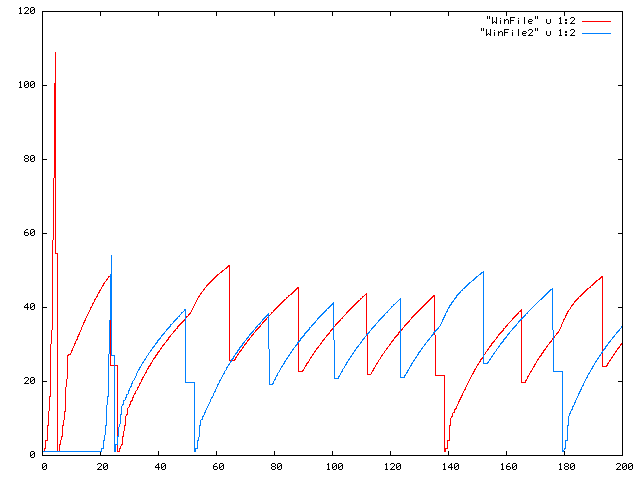
- DEMO:
(2 TCP flows sharing a DRR queue)

- NS Prog file: click here
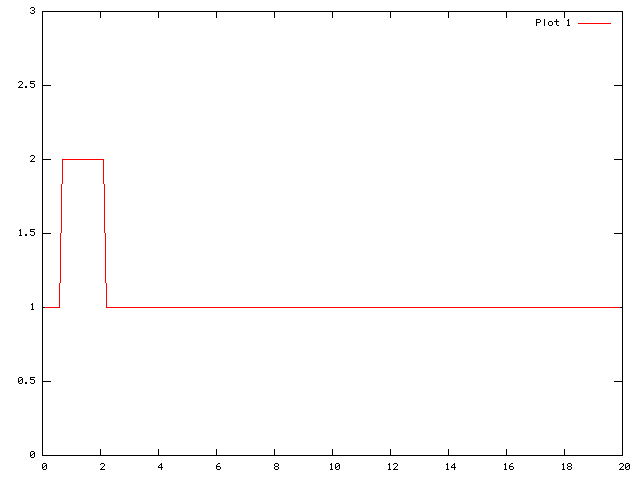
- TCP competing with an over-sealous UDP flow using
Drop Tail scheduling:
CWND of the TCP flow:
- DEMO:
(1 UDP vs 1 TCP flows)
- NS Prog - UDP and TCP flow sharing DropTail Queue:
click here
The UDP flow makes TCP use CWND = 1 all the time...
(Look at the NAM visualization and you will know why...)
- NS Prog - UDP and TCP flow sharing DropTail Queue:
click here
-
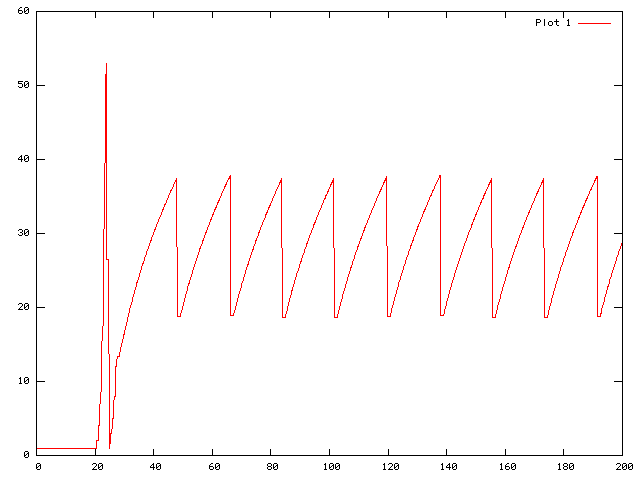
TCP competing with an over-sealous UDP flow using
DRR scheduling:
CWND of the TCP flow:
- Example Program:
(Demo above code)
- NS Prog - UDP and TCP flow sharing DRR Queue: click here
Note:
- You can see that DDR can provide TCP with a fair share of bandwidth even when the UDP flow transmits more than the bottle neck link.